Coming soon to London: Escape Land

Escape Land logo

Exciting times! News has arrived of another forthcoming exit game to London, Escape Land. This one will be situated very near the Cambridge Heath train station – or, if the Underground is more convenient than the West Anglia railway, within a few minutes walk of Bethnal Green. The site is taking bookings now, with the first game available from Saturday 14th June. The site will open with one game, which is set to have a sixty-minute time limit and will host teams of three to five players. The biggest gimmick is that there is a gorgeous-looking steampunk theme.
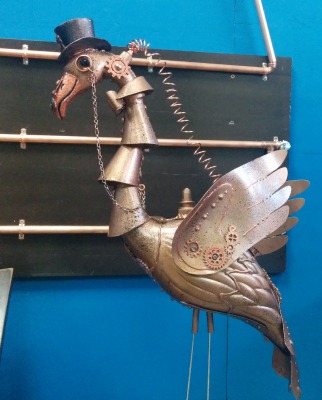

Steampunk sculptureMannekin in steampunk gogglesA little impudence has called in these two pictures of the goodies that are set to face you, and a little more reveals a teaser for the theme.

Would you want to live in a world where time travel is possible?

In the future, technology became so advanced that scientists found a way to open gates into different parts of the timeline. But after the first tests it quickly became visible that you can’t travel in time without consequences.

Every time someone did a trip through a time gate, catastrophic events occurred in the surrounding area. The bigger the group of travellers, the bigger the tragedy. It turned out even individual souls can’t play God and change their destinies in such extreme ways. If you don’t look after your body you get sick. If you are not willing to follow your given path, nature will find a way to show you that you were wrong.

After the first months the government had to set up emergency regulations. No one was allowed to travel in time anymore. They were monitoring everybody who had anything to do with current cutting edge technology. All the studies and information became classified. Former time travellers were hunted down. A small group of rebels managed to stay hidden in 1900. After years of hiding they tried to open a gate into 2014. It never turned out what their plan was. But this time gate happened to be two-sided.

When they appeared, a small group of people got sucked into the time tunnel and travelled back into the age of steampunk. You suddenly find yourself in the home of two strange scientists. They are telling you that you should not have seen their base and you probably have one hour left until the rest of their Illuminati arrives for their weekly meetings. One hour to escape from the age of steampunk. Good luck and have fun!

That’s distinctive, evocative and exciting; fingers crossed that the rest of the content can match up to what we know so far, and that the puzzles can match the standard of dressing. (Some of the photos of players are going to be priceless.) This looks like being a valuable addition to London’s exit game landscape and this site looks forward to reports after the game opens on Saturday week.

Virus Alert

Breakout Manchester's "Virus" graphicWith the discussion of the last week, perhaps there’s reason to be grateful that this doesn’t refer to any particular dangerous, insidious computer virus and refers to the strictly fictitious virus that is the subject of Breakout Manchester‘s upcoming second exit game room, advertised on the site as being due to open on Friday 6th June. It looks like quite a few sessions have been booked already.

“Can you slow down the outbreak and find the cure? You only have 60 minutes to do so or the fate of mankind may be in jeopardy. Our 2nd and newest room in Breakout Manchester. This room is completely unique and you will not find it anywhere else in the world.” Some early construction photos suggest that there is, as you might expect, a laboratory theme. The room may well also have a great deal of natural light, which is a little unusual when many sites don’t mind, or even embrace, a hint of claustrophobia to spur you on to escape. The theme and photos seem promising; this site looks forward to seeing Breakout Manchester’s first original room.

Breakout Manchester are conscientious about posting photos of their teams; while this is by no means unique to them, the players always seem to have had lots of fun. Whilst taking these photos in front of a wall, or a window, with the site’s name on is something of an exit room cliché, Breakout Manchester’s wall always particularly brings to mind a football manager’s post-game press conference held in front of a matrix of team sponsor logos. (Not a bad thing in the least!) Perhaps the logical conclusion would be the Italian press conference approach where the sponsor logos scroll along on a loop behind the manager as they talk…

If you’re not in Manchester, there are several exciting pieces of exit game news coming up soon that this site looks forward to sharing. Before then, the New York Times yesterday featured a superb piece about exit games, particularly the interaction and crossover between games and immersive theatre. The piece touches on other work by the theatre company Punchdrunk and also Gone Home; maybe the piece’s most significant original contribution is the collation of game designers’ quotes about exit games, but it does a fine job of neatly illustrating the common points of reference. Recommended reading!

You are not alone

A scroll and some actorsOne factor that seems to apply to many exit games is that the team playing them are in the room, alone except for contact with the outside world that may be supplying hints, whether by walkie-talkie, over a loudspeaker, onto a screen or by some other approach.

This solitude needn’t absolutely be the case; in the US, the Trapped In A Room With A Zombie series of games features a real live acted undead zombie in each room, chained to the wall. Every five minutes, the zombie’s chain is extended another foot so that they might have extra shambling radius. If the zombie touches you, you are… not eliminated from the game outright (that wouldn’t be fun, considering you’ve paid for the ticket) but have to sit down, rooted to the spot, and can only communicate verbally with the rest of your team.

This site is not aware of any UK exit game sites currently looking to increase their regular “fully manned” staffing levels. However, an exit game could be distinctive if it were to feature actors or other characters to interact with as part of playing the room. Yes, the cost of labour is expensive. (TIARWAZ, referred to above, has teams of 12 playing at any one time.) It might be possible for a single site with multiple games to contrive some sort of solution, though, with actors who are present at certain points of the game but not others.

One approach could be for these intermittent actors not to physically appear in the same space as the teams, though still to be available at certain points for crucial interaction. Could a game master from another game also act as a character when they happen not to be running a game or performing setup between games? Could it be possible to contrive a reason for a game master to be out of contact temporarily, while they are acting as a character in another game?

Another approach could be for one actor to play a variety of different roles (or play several simultaneous versions of the same character), dipping in and out of several games as appropriate. The entrances and exits would have to be very carefully handled in order not to disrupt the “exit the room” metaphor – there would have to be very convincing reason why an actor could get in or out of the room but the team could not use the same route in order to do so.

A real mind game would be to play fast and loose with the concept of a single permanent benign game master per group. For instance, you might interact with your game master for 80% of the hour in one way – then the game master might physically intrude into the game and interact with you in a different fashion for the rest of the game. Perhaps a game master from another game might continue to act as master for the last few minutes of your game, while you interact with this compromised game master as part of the game.

So many things that could be done, and this is surely only scratching the surface. Wouldn’t be cheap, but surely would be distinctive and memorable!

Around the World: the Washington Post’s “Post Hunt”

Washington Post "Post Hunt" logoOver the past thirty years, US humour columnist Dave Barry (and, recently, friends) have – slightly more often than not – set a public puzzle hunt for the newspaper that published them. Originally this was the Miami Herald‘s Tropic magazine, thus inspiring the hunt to be referred to as the Tropic Hunt. The Tropic magazine folded, but the Herald itself later sponsored what was later known as the Herald Hunt. Most recently, Barry and friends have been producing the Post Hunt for the Washington Post. Andy Wenzel’s archives are a great source of information.

The hunts have a common format, set up so that a (typically) high four-digit number of participants can play. Five simple clues with numeric answers are posted in the sponsoring publication, along with an annotated map of possible locations within reasonable walking distance, with a central stage highlighted. At midday, from the central stage, it is announced how to transmute the answers to the simple clues, in a non-obvious fashion, to map entries. This indicates the locations of the five main puzzles, which must be visited. At each one, a cryptic and possibly multimedia puzzle is available, whose answer is a number.

Between midday and 3pm, teams (typically of four players, but without size restrictions, and a single player team has won) visit the locations, solve the puzzles and generate the five numbers. At 3pm, another cryptic clue is announced at the main stage which can be interpreted to a sixth location on the map, at which the final instruction is given as to how to interpret the whole of the hunt and its intermediate answers in order to generate and submit the overall answer to the hunt. First team to do so wins. This year’s prize was US$2,000 cash.

The most recent Post Hunt took place in Washington DC on Sunday and the Post has a story about this year’s event, along with this year’s puzzles and answers. They look like a great deal of fun and initial reports suggest this was as good as any previous year’s hunt.

This year’s winners included Todd Etter, a long-time mainstay of the puzzle hunt community and a popular one, for his contributions have included being one of the team putting on The Famine Game, an epic and immensely well-regarded weekend-long puzzle hunt (coincidentally also in the DC area!) last year. Todd’s team also have won one past Post Hunt and taken two other top three prizes; Todd has written about his team’s 2008 win elsewhere.

The Post Hunt has such great imagination, budget, heritage and following that it must surely be regarded as one of the world’s great games of its type. There’s no reason why a British counterpart couldn’t do something similar; considering the love shown by Britons for our own puzzle hobbies, it would surely be as distinctive and popular a hit over here.

The League Table: end of May 2014

Picture of a generic trophyThis is the second installment of an occasional feature to act as a status report on the exit games in the UK. On its own it means little, but repeated sufficiently many times it could be the basis of a survey of growth over time.

Exit Game sites known to have opened in the UK/Ireland: 12/1
Exit Game sites known to be open in the UK/Ireland: 11/1
Exit Game sites known to have closed temporarily in the UK/Ireland: 1/0
Exit Game sites known to have closed permanently in the UK/Ireland: 0/0
Exit Game sites known to be under construction in the UK/Ireland: 3/0
Exit Game sites less confidently known to be under construction in the UK/Ireland: 3/0

Site name Number of exit rooms Number of different games Number of TripAdvisor reviews Number of 5/5 TripAdvisor reviews Local TripAdvisor ranking
Breakout Manchester 1 1 4 4 62
clueQuest 3 2 426 411 1
Cipher 1 1 – – –
Cryptopia 1 1 24 21 9
Escape 2 1 7 7 81
ESCAP3D 1 1 73 62 3
Ex(c)iting Game 2 2 17 12 22
HintHunt 5 2 805 748 3
Keyhunter 3 3 38 25 6
Make A Break 1 1 22 15 12
Tick Tock Unlock 1 1 9 9 19
Puzzlair 2 2 36 36 2
XIT 4 4 3 2 101

This needs to be taken with a heavy pinch of salt. This site supports all the exit games that exist and will not make claims that any particular one is superior to any other particular one. Please note that the TripAdvisor rankings represent a wide variety of locations and cannot be directly compared against each other. In fact, it’s probably pushing it even to compare the tripAdvisor rankings of two exit game sites in the same city. One site has received four ratings over the course of the month, all 5/5, and has promptly dropped six places within its city. Seems strange; what more might it do?

Updating our estimate as to how many people have played an exit game in the UK or Ireland, we will revise our prior estimate for the number of people by the end of April 2014 up to 34,000 and the estimate for the number of people by the end of May 2014 up to 39,000. (As usual, this is not a confident estimate, but should be correct to within a factor of three.) The expansion of HintHunt from four rooms to five at the start of June is likely to have a reasonably large effect in future months.

Interview with Paul Bart, CEO and Founder of The Escape Hunt Experience

Escape Hunt global logoHere’s a perspective you won’t find elsewhere. This site has already discussed Escape Hunt, set to open in London in August. There are already three Escape Hunt sites open, in three different countries, and the locations list details the ambitious expansion plans around the world, particularly over the short-term future.

Accordingly, it’s exciting to be able to feature an interview with Paul Bart, the CEO and founder. There are very few brands with a similar global perspective and profile, so Paul’s take on the genre, and his background, will be distinctive. The questions asked by Exit Games are tagged with EG and Paul’s responses with PB below.

  • EG: How did you get into “escape games”, Paul?
  • PB: I was looking for a new business idea a while back and I noticed around a year ago that a few escape games were spring up and doing well in other cities. I decided it was worth looking at how they were being run and what the potential was to expand with them globally. Unfortunately none had a truly global vision and I decided I had to go it alone. Hence The Escape Hunt Experience was founded.
     
  • EG: What is your background that could possibly relate to this?
  • PB: There are many factors here and, without boring you, let’s just say I have always been fascinated and challenged by puzzles. I was the kid who would stay up late at night in bed trying to figure out how to solve a maths or word puzzle. I also have a good psychology degree specializing in several areas one of which is IQ testing and another is data analysis relating to statistics. Add in many years of corporate training, seven languages and a lot of other eclectic experience and that might tell you why I love what I do so much.
     
  • EG: How do you see this market now and in say 12 months time?
  • PB: Now it is growing fast and it will continue to do so. There are two main types of players now – larger companies like us of which we are the clear global leader and then local games with one or maybe a send branch only. As time goes on, this will get more blurred with regional players, more different styles and a lot of different ideas. We are clear where we will be in 12 months time – around 100 branches worldwide in our own style but maybe more advanced games as this changes monthly.
     
  • EG: What is your current personal contribution?
  • PB: I run the business so I have a lot of strategic responsibility. I also oversee all the global marketing and franchisee relations. Most of all I love game design so that takes a big chunk of my time leading our global game design team based here in Bangkok.
     
  • EG: Which puzzles, games and other artworks have influenced you most over the years in your designs?
  • PB: That is a hard one! I love art – everything from Renaissance to Modern and also sculpture. I also love languages. Add in some darker stuff like the occult and great literature and you can see its very eclectic. Most of all we try very hard to be logical and balance our games. Many game providers don’t see the need for that but it is very important especially as we operate in so many countries with so many languages.
     
  • EG: If you could predict the future for escape games, what would it be?
  • PB: Growth, growth and more growth! Then some diversification into new areas. We have huge plans here. Watch this space as they say…
     
  • EG: Do you see it appealing to different markets in different geographies?
  • PB: Of course. It’s a global phenomenon. At our Bangkok branch we have seen nearly 20,000 players and I can’t think of a country not represented. It is a fascinating anthropological study, believe me. Filipinos are so different from Thais, Brits from Americans. They all have fun in different ways. Doing as much corporate work as we do is amazing too as we see global companies bring their worldwide staff – all very different styles!
     
  • EG: How, in practice, do different countries vary from each other in what their players are looking for?
  • PB: They all want fun but some are more serious. It sounds like stereotyping but it is true that Europeans take it more seriously and Asians take more photos afterwards as just one example…
     
  • EG: Have you identified any trends as to which nationalities prefer which styles of puzzle?
  • PB: Actually Chris, it is fairly culturally neutral overall. I see no bias for different preferences actually but If you ask me about ability, that is a totally different question. Asians are renowned for their quantitative skills whereas Europeans and Western nations in general are more qualitative. This bears out in game play too but it is also about initiative. Asian players are generally better at solving puzzles once they are “shown the way” if you like whereas western races grasp the idea quicker but then don’t make such good progress in average. It all equals out in the end pretty much and then differences some done to social factors such as assertiveness, cooperation and leadership. It’s a long story; maybe I can answer next time in a specific chat on this point.
     
  • EG: How do you deal with language issues, particularly in countries where there are a multitude of languages spoken or where tourists are such a high proportion of visitors that you cannot reliably make assumptions about what languages they speak?
  • PB: That’s a great question, Chris. We run both multi-language games and single language depending upon the location. Our Asian branches are multi but London will be single language. It is not always obvious which language either! Phuket will run in English and…. Russian. Not Thai as you would expect. Overall, we adjust for cultural bias and language in our games so language plays a very small role in overall game play. Bangkok is another great example of this. We run in Thai and English but despite even messages in Japanese on our website to say “we do not speak Japanese. These games are only in Thai and English”, such is our popularity amongst Japanese locals in Bangkok and tourists, they still come and speak absolutely not one word of Thai or English. We still have great fun using sign language and they leave with a big smile!
     
  • EG: Where are you based and how does that allow you to work?
  • PB: I am based in Bangkok but travel all over the world. I am on the road a lot setting up our game centres and I install all games personally. I love that…
     
  • EG: What is a typical day for you, Paul?
  • PB: There is no typical day but overall it is around 30% game design, 20% franchisee support, 20% marketing, 20% technical things and 10% on Bangkok branch.
     
  • EG: What are the most memorable reactions that you have witnessed?
  • PB: I have to say that large groups of Filipinos are the most exuberant when they solve the puzzles and then they all get so happy in a huddle but for me it is the 3-4 occasions where an older player has personally shaken my hand and thanked me for the “best time they have ever had with their grand children”… Really makes all the hard work worthwhile!
     
  • EG: What has surprised you in the last 12 months?
  • PB: A lot of things but mainly for us how successful we have been and how we have adapted our proposition to all the different cultures and geographies. In Bangkok branch, we also developed a huge corporate following without a single call to a company. They all find us. Singapore has also been so successful only a short time after opening it shows the power of our global brand.
     
  • EG: What have your years of corporate training experience taught you about how to tailor the experience when you offer corporate events?
  • PB: Wow! OK, the short answer is always understand beforehand what the agenda is. We have hosted ExxonMobil and Shell at one end of the scale and small local travel companies at the other end. The key is to know how they want to play things. Our website has a sample corporate agenda in the FAQ section but actually it is the whole atmosphere that counts. We always keep it fun and stimulating but we can also get into some deep coaching too if needed. I try to personally host each corporate event as I have the skills but we even get into quite esoteric stuff at times like hypnosis and visualisation techniques. It is all about what the client wants and we do cater to all needs…
     
  • EG: What would you say to anyone who feels they want to work in this industry?
  • PB: Go for it. It’s a great and exciting place to be. Whether as a game designer, game master or even the administrator, its never a dull moment. There will be courses at universities soon on “Escape Gaming” or as we call it, “Experiential Entertainment”.
     
  • EG: What misconceptions about the industry would you most like to dispel?
  • PB: I think all the press and feedback is positive. The only things I would say that are unfair are the criticisms of games at number one on TripAdvisor. We have been number one in Bangkok since a month after opening and we deserve it as we offer an extremely high level of satisfaction. Sure, we are not a temple, but maybe we offer better service and satisfaction! I guess the only other point is that the industry is not only for geeks as is often assumed. We are a major international company operating in many countries so its hardly geeky anymore – no more geeky than working for Apple, I guess!

    Thank you for your time, Chris, and letting me tell my story! For all those who want to be part of our future, we still have franchise opportunities available in many locations. For those who want to work with us, send us your resume via our website. We are hiring in all sorts of areas!

Thanks so much for that, Paul! This site very much hopes to feature more interviews in future as a way to get a variety of perspectives from behind the scenes. It also considerably adds to anticipation for the London opening, just a few months away.

Hidden Cash around the UK

A wad of banknotes from the "Hidden Cash UK" Twitter accountIn the last week, a successful property speculator has been hiding envelopes with moderate quantities of cash around cities near the west coast of the United States, posting pictures of the locations and not-very-cryptic clues to their whereabouts to their Twitter account. There is something of a “pay it forward” motif, though of course this cannot be enforced. Apparently it has spawned imitators; most relevantly for us, Hidden Cash UK has made three drops in the North in two days.

There are definitely possibilities here. As there have been many imitators already, there’s no reason why there couldn’t be more to come: there’s got to be room for a Hidden Cash GB, a Hidden Cash Ireland, a Hidden Cash London and so on. Some would consider a couple of hundred pounds a very adequate investment for thousands, or tens of thousands, of involved followers within a couple of days. If someone were to distribute Hidden Cash coincidentally outside their exit game site, then perhaps the site could attract the attention of those looking for it who are likely to be favourably inclined, though possibly unimpressed by a lack of subtlety. (Hiding the cash inside an exit game and charging people to play it might well be considered a bit cheek, though you might still get away with it.)

This probably has the hallmarks of being a half-a-week’s wonder on Twitter in its current form, but if the mainstream media decide to run with it then perhaps there’s a few weeks, or a few months in it. (Maybe more.) This is far from original, of course; Tom Scott and Dan W. ran Advent Locker in December 2012, which is similar but used prizes in Amazon Lockers, and you know that this site will take any opportunity it gets to link to the wonderful story of the newspapers’ own Treasure Hunt Riots, a little over a century earlier. (Also a salutary reminder of the potential dangers of such things. Dan and Tom did nothing more ill-willed than having their Christmas Eve prize be a good old festive RickRoll, but not all patrons need be so benign.)

Treasure hunts themselves are far older; the parallels to geocaching are obvious, and that is so well-known that it need not be explained. Arguably Hidden Cash has a closer connection to its GPS-less, clue-heavier predecessor, letterboxing, which has been dated back to 1854.

There has to be something exciting and relevant to do while Hidden Cash is fresh in people’s minds, and that may not be for too long…

All the news from the exit games

7segmentsIn some browsers, the up- and down- arrows above will take you from zero to twelve and back…

Here’s a quick round-up of exit game news:

  • Escape in Edinburgh are holding their “The Escape Games” promotion between Friday (er, tomorrow) and Sunday. Teams of 3 or 4 can pay just £30/team (half price!) to try to escape either of the two identically-dressed rooms. The fastest teams win free games plus T-shirts or mouse mats.
  • Whether you win or not, Escape have posted a teaser for their Dark Room set to open soon, with another message suggesting there may be a prison theme.
  • In other “new room” news, Breakout Manchester (who are struggling with their web site right now, but are taking bookings by e-mail) posted a tweet saying that they will open their second room, Virus, from Friday 6th June. Looking forward to catching the bug!
  • Escap3d of Belfast say that “Our Great Challenge is back! If you get through the puzzles with your own work and open the door within the allocated 60 minutes, you can invite a team of friends for free or we pay you back the admission.” Sounds like exactly the right sort of fighting talk aimed towards purists with a no-clue disposition.
  • Clue HQ of Warrington have posted rather a fun teaser video, an early construction photo and job ads. The site says “We’re currently gearing up for opening towards the end of June 2014” so not long to wait now.
  • The site has previously pointed to discussion of exit games on episode 41 of the The Cultures podcast; the topic is discussed again at the start of the new episode 45 as another member of the team tries a game and reports their experiences. I won’t spoil whether they had a good time or not but you can guess!

Around the World: True Dungeon

true-dungeon-logoThis entry might consume a little of the site’s “near-topic” credit, but the game it discusses is sufficiently close to being on-topic and sufficiently interesting that you’ll hopefully enjoy reading about it anyway.

Since 2003, True Dungeon has been an annual feature of the giant GenCon tabletop gaming convention that happens annual in August(-ish) in Indianapolis. It is a swords-and-sorcery-themed live action game that sees teams of players form an adventuring party to defeat a number of thematic challenges placed in their way. On a matter of semantics, many – most? – consider it to be a slightly different kind of game to a role-playing game as the players are not actually required to adopt characters, though players do adopt character classes, powers and capabilities familiar from the genre. It would not be too perverse a misinterpretation to consider the overarching game to be a series of seven consecutive, linked, 12-minute exit games with unusual mechanics.

Many traditional RPGs require the adventuring party to defeat creatures that they encounter through combat. Instead of the traditional dice-rolling of a tabletop game, or the padded weapon physical combat found in many live action RPGs, combat here is simulated by the physical challenge of a shuffleboard-like game where the sliding of a disc determines whether a blow lands and how much damage it does. Attempts are made to give as many different characters as thematic an experience as possible; players representing classes associated with the study of magic have some degree of real-world memory test in order to perform their spells (etc.) with maximal effect, and players representing rogues may have a physical dexterity challenge to perform in order to achieve in-game feats. (Possibly with real-world consequences if this real-world challenge is failed!)

Traditionally, the same story has been offered to players in two slightly different formats. Some people like to emphasise the simulated combat encounters, and these can be dialed up slightly. Alternatively, it is possible to play through the same story with less of an emphasis on the combat and more of an emphasis on puzzles. To an extent these take the form of the riddle trope found in fantasy stories; to an extent, some of these can be quite abstract. Possibly the best way to get a feel for them is the images gallery from over the years. Some of the brainteasers do feel rather familiar, though they need to be put in proper historical context. For instance, the challenge that is effectively a 7×7 irregular word sudoku was featured long enough ago that it would have pretty accurately blended unfamiliarity with accessibility at the time.

The game does feature plenty of physical aspects by way of attempting to trigger as many of the senses as possible. The rooms contain actors and reportedly spectacular animatronic creatures to this regard, arguably drawing from the US haunted house tradition. (Sadly for me, they have incorporated sufficiently many aspects of this haunted house experience in the past that I would happen not to feel quite safe trusting the game’s sense of taste.) A very considerable budget goes into making the game happen; participation is priced at $48 per player for a two-hour experience (of which, essentially, 84 minutes is the live game) which is probably on par with most US exit game tickets, on a minute-by-minute basis, these days. There are multiple stories and multiple difficulty levels offered each year, so people can and do find it worthwhile to play several times over the four days of the con.

Additionally, some players choose to show patronage by purchasing real-world tokens which offer in-game advantages. While this trading-card-game-like aspect has flourished over the years with a thriving secondary market, there is a fine balance to keep the entirety of the story accessible and enjoyable for those who choose not to participate. The forums suggest that the most dedicated players devote as much passion and resources to this single game as they might to a trading card game over the course of the year; these optional purchases contribute, I get the impression, a sum of the order of tens of thousands of dollars per year towards the cost of making it all happen.

Being played in one place globally for four days per year, this is something of a niche game. Nevertheless, most of the players who like it really, really like it; almost 8,000 tickets became available just over a week ago, 93% of them were sold within 32 hours and you might have to scrabble round to find a spare ticket, possibly by resale, even now. The existence of True Dungeon makes the gaming world a richer place.

DASH 6 by the numbers

DASH logoPlease find below an updated version of a table which details the number of teams on the scoreboard for each city in each edition of the DASH puzzle hunt to date.

Location DASH 1 DASH 2 DASH 3 DASH 4 DASH 5 DASH 6
Albuquerque, NM – – – 6 6+1 3+2+0
Austin, TX – 2 11 12 13+4 10+4+0
Bay Area, CA Y(SF)
Y(PA)
7(SR)
59(LA)
16(SR)
74(SM)
73(SF) 34+7(SF)
32+3(HMB)
53+17+0(SF)
39+5+0(C)
Boston, MA Y 18 26 29 27+2 30+7+1
Chicago, IL – – 17 14 10+1 15+9+0
Davis, CA – 16 15 16 13+7 8+7+1
Houston, TX Y – – – – –
London, UK – – – – 6+2 8+13+0
Los Angeles, CA Y 7 22 21 15+4 15+2+0
(Pasadena)
Minneapolis, MN – – – – 8+7 7+4+0
(recast)
New York, NY – 12 24 25 30+7 26+15+2
Portland, OR Y 6 17 19 19+2 11+7+0
San Diego, CA – – 7 – – –
Seattle, WA Y 32 47 49 49+2 58+4+2
South Bend, IN – – – 1 – –
St. Louis, MO – – – 2 2+3 –
Washington, DC Y 14 22 33 31+1 27+5+0

Here are my initial thoughts:

1) Errors and omissions excepted, with my apologies in advance. The Minneapolis recast figures come from the organisers by private e-mail.

2) The numbers are drawn from the scoreboards and may not reflect teams that participate but do not make the scoreboard for whatever reason, or other infelicities. DASH 1 does not have a public scoreboard on the web site and thus “Y” represents the hunt having happened there with an unknown number of participants. When there are pluses, the number before the first plus reflects the number of teams on the experienced track, the number after the first plus reflects the number of teams on the “new players” track (DASH 5 and 6), and the number after the second plus reflects the number of teams on the junior track (DASH 6).

3) Interpret “Bay Area, CA” using the following key: SF = San Francisco (1, 4, 5, 6), PA = Palo Alto (1), SR = Santa Rosa (2,3), LA = Los Altos (2), SM = San Mateo (3), HMB = Half Moon Bay (5), C = Cupertino (6). I apologise if some of those locations are not really in the Bay Area. (If you tell me that I am a bad person for jumbling Santa Rosa in with the others, I’d believe you.)

4) It’s not a competition to see whose DASH can be the largest; all DASH organiser teams are glorious, generous paragons of virtue, whether their event had one team or 70+, and the community at large thanks them all for the time and effort that they put in.

5) I think it’s fair to say that DASH 6 was a little troubled, with both Seattle and Portland briefly removed from the list of participating cities; thankfully, both cities eventually found local Game Control teams, and I’m sure everyone is particularly grateful there. There was discussion of locations in Phoenix, AZ and Pittsburgh, PA, but sadly neither came to fruition; thanks to people who put in the effort there, all the same.

6) Again, it probably reflects well on the decision to have parallel “experienced” and “newcomer” tracks at DASH 5 and DASH 6 that every city had at least one team playing each track. Indeed, the number of teams on the “new players” track rose from 53 to 101, further justifying its purpose. The junior track may take a little longer to gain traction.

7) I’m in two minds about the Minneapolis recast. The more people who get to join in the DASH fun, the better, but the three-week gap between the first run and the recast means that a lot of the momentum has been lost before people can talk about it, so there hasn’t been nearly as much buzz about a tremendous event as there might have been. (Us UK solvers can talk, given that we held discussion of DASH 5 back a week last year, so perhaps the point of comparison would have to be DASHes 4 and earlier.)

8) There are definitely several other countries to which DASH might expand in the future: given that Sydney and Melbourne have famous and popular puzzle hunts, there’s no reason why there couldn’t be DASH locations there. Closer to the US, Snoutcast recently had Stacy Costa from the University of Toronto, so clearly there is puzzle interest in Canada. Every other English-speaking country is a possibility; maybe even non-Anglophone major world cities with significant expat communities could host DASH some day.