Coming soon to London: Escape Rooms’ “Room 33” and Escape Hunt

Big Ben and its surrounding tower in London(Public domain photo via London Pictures.)

Two very exciting developments are coming soon to London. Escape Rooms opened a little over a month ago and its first room, the Pharoah’s Chamber, is already earning TripAdvisor reviews that are proving first class. The site’s second room, entitled Room 33, is scheduled to open this Thursday, 18th September, and the site is taking bookings already. The site is proving popular, particularly at weekends, with people who have enjoyed the site’s first room likely to come back to try the second, so you may well want to book soon.

The story behind Room 33 is that of a heist. As a guard to the emperor of the 17th century Qing dynasty of China, a valuable porcelain vase (believed to ensure that the dynasty will last forever) is stolen on your watch. Players travel through time to Room 33 of the modern-day British Museum, hence the name, and have to retrieve the priceless artefact and return it while your time machine’s portal remains open. Sounds intriguing and this site looks forward to hearing whether the second room matches up to the first.

A little further ahead, faithful reader Dean has pointed out that London’s Escape Hunt has published its location: 5 George Yard, right at the heart of the City of London, close to Bank station and within a javelin’s throw of some of the most famous old business institutions of the capital. While bookings are not being taken quite yet, The London Sinner have more, tantalising, detail, including a projected opening date: 3rd October.

The article suggests that the location will have ten(!) rooms, offering three different games. (While this site doesn’t yet have sufficient information to claim this as a record, a fortnight ago, The Mindtrap in Thessaloniki was being claimed to be Europe’s largest with only – “only”! – six. There are different ways of measuring “largest”, of course.) Quoting The London Sinner:

Find the murderer of a famous artist, save the life of a kidnap victim and, in a completely new departure for The Escape Hunt, track down the antidote to a deadly poison in an enigma especially created for the London experience(…)

All three games sound exciting, and the sprinkle of stardust is something new and distinctive. It’ll be a lot of fun to find out!

Girls and Boys Came Out to Play

"Girls and Boys Come Out to Play" bannerThe “Girls and Boys, Come Out to Play” hunt in central London today was a smash hit! Two little teams merged at the last minute, so all told there were seven teams of six-ish walking around London and solving puzzles, mostly within an assortment of pubs and cafés. The hunt started just outside the Tower of London, went as far west as the Southwark Bridge, then back as far as south as the Borough Market and completing the loop by finishing with a tour of the St. Katharine Docks. There was a good four miles walking over the course of the day, maybe more.

Apart from the conclusion, there were nine locations among the way. Most of the nine locations had an extremely mild, though highly thematic, physical challenge that had to be conquered in order to earn your team the location puzzle. The puzzles were all of a very high standard, in the usual puzzle hunt answer extraction format. The hunt followed the “leisurely mini-game” tradition, with no scoring and hints provided generously, which led to a really relaxed, happy atmosphere, and no formal comparison between team performances.

I get the impression that our team were probably the fourth finishers of the seven, though this is fairly meaningless as we don’t know how many hints teams took, or how long teams took to break for lunch and so on. That said, for most of the puzzles, we often missed some of the deliberately included subtleties which would have led to a really clean-feeling, precise solution… and ended up feeling that it was our imperfection, not that of the puzzle. It doesn’t really matter, as the goal was to have fun, and that was achieved in spades.

It’s not clear whether the hunt will ever be repeated, but it could be; if there’s an arguably negative criticism of the hunt, it’s that the puzzles were not especially exactly tailored to the locations used. This is far from an inherently negative judgement, as it would permit the hunt to be run again elsewhere around the UK, which could be an excellent thing for the national puzzle hobby. (There was some pretty strongly British content, though, so rerunning it overseas would take more work… though it wouldn’t be impossible by any means.) Accordingly, there might not be too many specifics about the precise ways in which the puzzles were spectacular, just in case. With only 40-ish players, there were a great many people who missed a real treat, but it’s nice to consider the possibility that you might not necessarily have missed this treat forever.

Outstanding fun and superb company. Many, many thanks to the organisers who have worked long, hard and extremely successfully to create a wonderful day for all the players.

Coming up in London this week

"Puzzled Pint" logoThere are a couple of very exciting events coming up in London over coming days. Tomorrow sees the Girls and Boys, Come Out to Play puzzle hunt, starting in central London. This site has previously discussed the event and registration is long closed, so if you’re interested but don’t have firm plans then your only hope is to try to find a team looking for another member. (Perhaps posting to the Facebook page might do the trick, but it’s mighty close to the event already.) If you’re reading this and will be there tomorrow, do make yourself known to me at the event; the weather looks fair enough that I’ll likely be wearing a purple T-shirt and jeans.

Whether you’re there or not, there’s also Puzzled Pint on Tuesday, also in London. No registration is necessary for this, though a simple but thematic location puzzle has been posted, which needs to be solved in order to find the location of the pub at which the event will be held. Recent months have seen about ten teams take part at the London event, so the pub has been chosen to easily deal with an additional 50-ish-ish visitors drinking and solving.

Puzzled Pint is a free-wheeling, deliberately accessible contest held between teams of three(ish)-to-six(ish). Either turn up with a ready-made team or turn up and form a team on the night. The organisers will be there between about 7pm and about 11pm and will hand each team, when they are ready to begin, probably four or five puzzles to solve. Hints are freely and readily available, with the emphasis being on fun and every team having getting as much help as they want. The puzzles are free; the pints aren’t.

One of the excitements of Puzzled Pint is that the same event is taking place in cities throughout the English-speaking world. For the longest time the event took place only in Portland, then spread to Seattle. Over the last ten months, the number of cities has risen from two to three to five to six, but there’s never been a jump quite like this month’s as there will be ten locations – London and nine in the US, with new entries being Boston, Washington DC, Austin (all of which have strong DASH traditions, so surely should be quick to pick up the Pint habit) and a second Seattle loation, “Seattle Eastside”, as the first has grown big enough to split in two.

I’ll be at this Puzzled Pint and it’ll only be my second London event, though my wife is a regular. Again, I can’t wait – and, again, if you’ll be there, do let me know. It should be great!

All the news: hunts, contests and more

NewspaperThe site has been slow recently due to a nasty case of moving house. If you can stay put somewhere for a long time, it’s a wonderful thing. Still, these are decisions that have to be taken as a family, and you’ve got to go where the work is. Nobody came here for ranting on renting, either, so on to the news.

There are a couple of new hunts listed in the calendar, as Treasure Hunts in London have announced a hunt in historic Chingford and a second with the title “Drink to me only”, both coming up in September.

Past events are not lost to the mists of time but are stored in the calendar archive, and it’s worth following up a couple of events listed there. Mark Goodliffe did the double of winning the puzzles (sudoku and Kenken) competition at this year’s Mind Sports Olympiad and also the recent finals of the Times Sudoku championship, putting him commandingly atop the hypothetical money list for 2014. All three podium positions in both events were taken by UK Puzzle Association members; congratulations all round!

Previously this site also covered the recent puzzle hunt at the Manorcon board games convention; further to that, this site thoroughly recemmends the recent Snoutcast episode that featured an interview with hunt organiser Annie Percik. Snoutcast episodes are habitually excellent, and about 85% of them focus on puzzle hunts; in previous years, the podcast racked up 200 near enough weekly episodes, and this year the podcast has gone to a focus on monthly(-ish) interviews, focusing on women who make puzzles. Strongly recommended.

Lastly, you might notice a revamping of the blogroll at the right, for this site is in the fortunate position of having so many great blogs to link to that it’s worth categorising them for ease of use. A new Toronto Room Escape blog has got off to an excellent start, and Intervirals has added some forums, of a type that the hobby does not currently have, that may well take off over time.

Hunts coming up

"A Stab In The Dark" logoWord reaches this site about a couple of interesting-looking games coming up in the UK at the start of October. It’s arguable whether or not they have as much overt mental focus as something like DASH or similar, but they involve going from location to location, finding clues and solving them. That gives them, near enough, the puzzle hunt nature and makes them relevant as far as this site is concerned. (More about some more very clearly hunt-y hunts coming up soon.)

A little over four months ago, this site covered A Door In A Wall, previewing their Diplomatic Corpse game that ran in London through May and early June. Happily, they’ve got another public game coming up in London: A Stab In The Dark, set in the world of 1970s schlock horror movies. “Adult situations, naughty words, squeezing into tight spaces and a lot of walking” are promised as you “(…) follow the clues, gather the evidence and catch ((murdered horror movie megastar Don Gowin’s)) killer“, so this is not one for the kids. Perhaps there might be something of the feel of the haunted house to it in parts; terror attractions are becoming bigger business in the UK these days.

Games start at 6pm on Wednesday to Sunday evenings from Friday 3rd October to Sunday 2nd November; teams of threeish-to-sixish (or register by yourself and join a team) should each bring comfy shoes, at least one video-capable smartphone per team, and senses of adventure. £30/player gets you 4½ hours of fun. (Alternatively, if you’re scared of the dark, matinee performances starting at midday at weekends are also available.) Already 12 of the 33 performances have sold out completely, mostly at weekends; this has to be a vote of confidence and shows the company has dedicated fans coming back from one game to the next, so don’t hang about.

If you’re closer to Cardiff than London, though, there’s a one-off game in the Welsh capital called Eye Spy 2 from 3pm to 6pm on Saturday 4th October. Again it’s a team game, involving “travelling between several locations, finding and solving clues, playing games and saving the world no less“, and again it specifies a lower age limit of 18. There is a requirement for good vision, hearing, some degree of cardiovascular fitness and mobility of extremities; running shoes and dark glasses are listed as essential basic spying equipment to set your expectations for quite a kinetic game. Smartphones and cameras (presumably cameraphones would count here) are also listed as being necessary per team.

This site isn’t familiar with the first game in the series, but the thinkARK group putting it on have plenty of past form, having hosted enticing-looking playARK festivals in Cardiff in recent years, and co-designer Julian Sykes’ blog also gives some hints as to the thinking behind the event. The booking page also has a video that may reveal even more still. There’s a limit of 75 players and tickets are about £16/player, cheaper if you book before 5pm on Tuesday. (Er, the event is almost completely sold out already, as it is, so again quick action is required.) Is there a secret agent in you?

As ever, you’ll find details of these events and all the others know to this site on the event calendar. Get your diary out!

World Puzzle and Sudoku Championships, London 2014: a personal opinion

"FIN" film stripThis will very probably be the last post this site makes as part of its London 2014 coverage. This site generally tries to keep its coverage relatively neutral and personality-free; this, unusually, is an opinion piece from one of the Exit Games UK authors.

It’s probably no surprise that people in the UK Puzzle Association started seriously kicking around the idea of bidding to host the World Puzzle and Sudoku Championships in the UK around the time of the 2011 event; the bid to host the event in 2014 was made, and accepted, as part of the 2012 championships. At the time, I was a dissenting voice. My opinion on the proposed bid ran as follows:

Bluntly, but completely honestly, I think 2014 is – at the very least – a year or two too early for the UKPA to be considering running the annual WPF tournaments. I get the impression that it’s going to be a huge process and will largely consume the efforts of the association for a year or two.

While the UKPA is so small, my preference would be to spend at least the next couple of years focusing on expanding our membership and getting a strong domestic puzzle scene going, so that we can build up really strong and enthusiastic resources before we take on the biggest project of them all.

I sent this by private message to the UKPA’s directors. It was clear that mine was a minority opinion, so I had my say once, left it at that, and drifted away from the UKPA, leaving them to do their own thing. They do it extremely well; I wrote a preview of the UK Open face-to-face puzzle and sudoku championships in March, and of their online UK Puzzle Championship, probably my single favourite long-form online puzzle contest each year, in May. I’ve given publicity to the UKPA’s activities where and when I can, without otherwise being involved.

After having attended the face-to-face UK Open events in 2012, I was convinced that, while the UKPA membership was small, it had sufficient talent to be able to run the world championships… barely. I would never have said that I thought they couldn’t do it, but I did think (but not say out loud) that, in practice, the organisation was so small that they couldn’t do it without driving themselves incapable through overwork, to the point of putting the organisation itself at risk.

The last two weeks show that, as it turns out, I was wrong. I acknowledge that and am delighted to have been proved wrong.

It’s likely that the team putting together the event was one of the smaller teams in recent years. It’s definitely true that there was an immense amount of work put in long before the event came to fruition, and very little sleep indeed was had by the people running the event while the week itself was in progress. I haven’t yet seen a great deal of long-form blogging about the event itself (though see Roland Voigt, Palmer Mebane and the Canada team) but the social media instant feedback I’ve seen has been extremely positive.

Accordingly, while there is not yet necessarily much primary source material to suggest how this year’s championships compared to previous years, the second-hand feedback implies that it was about as good as the event has yet been, and certainly at the very top end of expectations. I get the impression that the event was relatively low in terms of bells, whistles and miscellaneous “jazzmatazz”, but that the important bits were all present and correct. Certainly there were no broken puzzles, which is to the event’s massive credit.

While thanks and praise should be given to puzzle authors from around the world, for the puzzle-writing has been a global task for years now, as far as editing and testing are concerned, the buck stops with the local organising committee, and they did not disappoint in the least in that regard. Full spreadsheets have now been published with the World Sudoku Championship scores and World Puzzle Championship scores; while my preview may not have picked the winners, I’m adequately pleased with the extent to which I was there or thereabouts.

Many congratulations and great gratitude to the organisers and volunteers who put on the year’s event. Their hard work and excellent results have done the UK proud. Next year’s championships have been announced as taking place in Bulgaria; if you’ve enjoyed this site’s coverage of this year’s events, and think you might enjoy taking part in an event that will get covered in the same way around the world next year, start your practice now! Details of qualification for the 2015 UK teams will be published as soon as they are available.

Winners

By Svilen.milev (Own work) [CC-BY-SA-3.0 (http://creativecommons.org/licenses/by-sa/3.0) or GFDL (http://www.gnu.org/copyleft/fdl.html)], via Wikimedia CommonsDetails of all the award-winners from last week’s World Puzzle and Sudoku Championships have been posted:

2014 World Sudoku Championship

World Sudoku Champion
1) Kota Morinishi (JPN)

2) Tiit Vunk (EST)
3) Bastien Vial-Jaime (FRA) & Jakub Ondrousek (CZE)

World Sudoku Team Champions
1) Japan

2) Germany
3) China

World Junior Sudoku Champion (Under 18)
1) Dai Tantan (CHN)

2) Jin Ce (CHN)
3) Sun Cheran (CHN)

World Junior Sudoku Team Champions (Under 18)
1) China

2) Korea

World Senior Sudoku Champion (Over 50)
1) David McNeill (GBR)

2) Jiri Hrdina (CZE)
3) Stefano Forcolin (ITA)

Best WSC Newcomer
Dai Tantan (CHN)

2014 World Puzzle Championship

World Puzzle Champion
1) Ulrich Voigt (GER)

2) Palmer Mebane (USA)
3) Florian Kirch (GER)

World Puzzle Team Champions
1) Germany

2) Japan
3) USA

World Junior Puzzle Champion (Under 18)
1) Qiu Yangzhe (CHN)

2) Olivier Garconnet (FRA)
3) Mehmet Durmus (TUR)

World Junior Puzzle Team Champions (Under 18)
Korea

World Senior Puzzle Champion (Over 50)
1) Stefano Forcolin (ITA)

2) Jiri Hrdina (CZE)
3) Nick Baxter (USA)

Best WPC Newcomer
Yuki Kawabe (JPN)

Many congratulations all round! Computer power supply problems here, so further exciting things will have to wait for now.

(Image credit: By Svilen.milev, via Wikimedia Commons; mouseover the image for license details.)

“And STILL… undisputed championofthewooooooorld…”

Ulrich Voigt, ten-time World Puzzle ChampionThe photo above, taken by the Japan Puzzle Federation, is of Ulrich Voigt, shortly after winning third place in the World Puzzle Federation’s in-person final of their year-long GP competition. This was just a warm-up for him, preparing his defence of his individual title. The previous post saw him listed as number one seed going into the play-offs.

The quarter-final saw finishers numbers seven to ten compete over three puzzles, for a single spot in the semi-final, with the lower-ranked finishers suffering late starts relative to the seventh-placed finisher by way of a handicap to penalise them for their lower finish. Bram de Laat of the Netherlands started the quarter-final first, by virtue of his seventh place finish, Zoltan Horvath of Hungary started second for finishing eighth, Japan’s Kota Morinshi finished ninth and so started third, and the USA’s William Blatt started fourth, having being promoted to a tenth-place finish upon appeal. (Previous tenth-place finisher Roland Voigt responds very reasonably.) The first puzzle, a Slitherlink (a.k.a. Fences, Rundweg etc.) was probably the one that had the biggest impact in the quarter-final; Kota Morinshi overtook the two previous starters and never looked back, even after having to erase a big chunk of his third puzzle. Kota finished the quarter-final first to reach the semi-final, and the potential double championship remained on!

So, in the semi-final, Kota Morinshi started some time after sixth-placed finisher Peter Hudak of Slovakia, somewhat longer after fifth-placed finisher Hideaki Jo of Japan and even longer still after fourth-placed finisher Palmer Mebane of the USA. In Palmer’s own write-up, he talks about the five puzzles he faced. He points to an unusual technique that he used to crack the Suguru puzzle, on his way to defend his fourth-place finish and qualification for the final.

Palmer had a 4’20” penalty to make up, with third-place finisher Florian Kirch of Germany suffering a 3’40” hold and second-place finisher Ken Endo of Japan having to wait 2’49” until after first-placed qualifier Ulrich Voigt of Germany started his final. This was longer still at seven puzzles: in order, Battleships, Area 51, Kakuro, Nurikabe, Unequal Length Maze, Neighbours, and Masyu. Mebane spotted a quick constraint on the 3-length ships to make up much of the time disadvantage on the Battleships puzzle, and was fast on Area 51 and Kakuro despite a minute-long penalty for a wrong answer on the second and 30 seconds struggling with a false solution to the third. After catching up further on the Nurikabe, Palmer writes:

(…) Unequal Length Maze is a fiddly Erich Friedman type without a lot of logic in it. An odd choice for a playoffs. Apparently this one went really poorly for Ken Endo, leading to his eventual 4th. In contrast, I saw a way to include a path pattern I often see in the solutions for these and finished it in 15 seconds. I was rather incredulous at this, my invigilator David McNeill was moreso (…) and Josh Zucker from the USA B team said it was his favorite solve of the championship.

Palmer made up more time still on the tricky Neighbours and final Masyu, so had come back a long way from his 4’20” initial deficit. Not quite far enough, for Ulrich Voigt had finished 22 seconds earlier to claim his tenth world championship. (This is the first time he’d won three in a row, and the first WPC “threepeat” since Wei-Hwa Huang bowled a metaphorical turkey in 1997-1999.) Florian Kirch was also making up time, finishing within a minute as well to take the third step on the podium. Full results to follow shortly when available. Congratulations to all the play-off participants, and to the top-placed teams as well.

The whole concept of a play-off for the finals remains slightly controversial, though it has been well-established since 2000. There is scope for criticising the extent to which the results of the first two days of competition are, arguably, close to thrown out when the result of the handicapped fifteen round decide the overall result. It’s almost a made-for-TV finale before the event has started to attract TV coverage. There have been a variety of play-off formats used over the years; this year’s was relatively well-received, for making the headstarts relatively large while keeping the solving interesting. It’s interesting that Palmer Mebane fairly explicitly targets finishing first before the play-offs over finishing first in the play-off, and he’s not alone in that opinion. Nevertheless, there are no realistic signs of play-offs being removed from championship consideration in future years.

Stretching back to last century, perhaps American Gladiators is to blame?

Finals day at the World Puzzle Championships

Europe's "The Final Countdown" single coverTwo days down and one day to go at the World Puzzle Championships! Arguably today is the single biggest day in the world puzzling calendar.
Usual source Akıl Oyunları points to a scoreboard photo taken by Rejtvényfejtők Országos Egyesülete, which I believe is the Hungarian puzzle organisation. Germany are leading the team competition with a single round to go from Japan, by almost a thousand points. Germany B are in unofficial third place, but ineligible for the podium; in the official third place is the US team, but are only barely ahead of Slovakia in fourth place. There’s a long gap between the first two and third place – so, barring a remarkable disqualification from the final round, it’s practically head-to-head between Germany and Japan for the title. The fifteenth round, the final one before the individual play-offs, is a purely team contest:

This team round consists of three phases. The first two phases take place in one session, and the third and final phase takes place in a second session, with a break before it. In the first phase, which covers puzzles 1-4, each team will be seated at a table and will be asked to solve 4 separate paper puzzles. (…) In phase 2, which covers puzzles 5-7, the players move counters according to given rules in a series of steps. When the team are satisfied they have found the final position of each counter, they should mark the locations with the given stickers.

Bonus points will be awarded for teams who finish all 7 puzzles correctly in the allotted time, as
per the other team rounds. In addition, the first 8 A-teams to submit a correct set of solutions for both of the first two phases will qualify for the third and final phase. (…) Teams that successfully complete the final round will be awarded further bonus points according to their ranking position: 1st=2800 points, 2nd=2000 points, 3rd=1400 points, 4th=1000 points, 5th=700 points, 6th=500 points, 7th=350 points, 8th=250 points. In the final phase, the team players will themselves act as counters moving around a large grid on the floor, with each player playing the role of one of the four counters.

So Japan have a fair bit to do in order to catch up with Germany. If Japan complete the final round correctly and Germany don’t, that will be enough, but this seems unlikely. If Japan complete the first two phases more than three minutes more quickly than Germany, then they’ll be within 800 points of Germany and just need to win the third phase outright. However, if neither of these is true, barring a German meltdown, Japan will need to beat Germany in the third phase by at least two places to overtake them. Slovakia are within a couple of hundred points of the USA, so overtaking them to reach the podium looks like a distinct possibility.

The individual play-offs take place this afternoon, with the ten finalists being, in descending order of score:

  1. Ulrich Voigt, Germany
  2. Ken Endo, Japan
  3. Florian Kirch, Germany
  4. Palmer Mebane, USA
  5. Hideaki Jo, Japan
  6. Peter Hudak, Slovakia
  7. Bram de Laat, Netherlands
  8. Zoltan Horvath, Hungary
  9. Kota Morinshi, Japan
  10. Roland Voigt, Germany

The top-placed UK finisher was Neil Zussman, who missed the play-offs by fewer than fifty points when Roland Voigt overtook him to take the tenth spot in the last individual round. So close…

More later. This site doesn’t normally do multiple posts in a day, but finals day is an exception!

Friends in high places

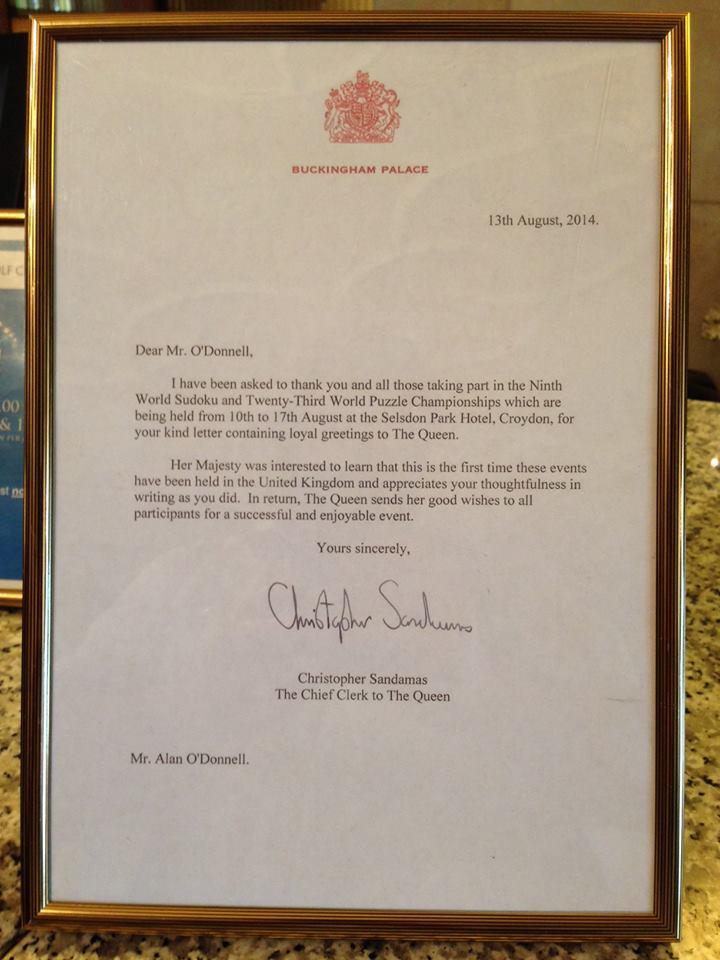
Letter from Buckingham PalaceOne of the star guest attractions at the World Puzzle Championship is the above letter, sent in response to a letter informing Her Royal Highness Queen Elizabeth II of the event’s existence. Probably most of the event attendees have their own photos of the framed letter; credit Akıl Oyunları for that particular photo, that does well at avoiding the glare of reflection from the frame. (Unusually for this web site, click on it for a closer look.)

Akıl Oyunları also takes the credit for recent photos of the World Puzzle Championship scoreboards after five rounds: the team scoreboard has the German team narrowly overtaking the Japanese team after round five (and the USA team being fought hard by the German B team) though there has been some nip-and-tuck in the battle between them, and the individual scoreboard shows Germany’s Ulrich Voigt starting to pull away from the field.

For further live updates, keep following Akıl Oyunları’s Facebook page and perhaps also the German-language “Live from London” thread on the Logic Masters Germany page. The Canadian puzzle team weblog is being frequently updated as well, as is Palmer Mebane‘s weblog. On Twitter, English-language discussion was tagged #worldsudoku for the world sudoku championship and is being tagged #worldpuzzle for the world puzzle championship. If you know of other sources, please post them in the comments below.

The in-person final of the World Puzzle Federation’s GP competition was last night. The “Live from London” thread referred to above had the play-by-play and the Japan Puzzle Federation have a photo of the scoreboard. It must have been great fun to watch the scoreboard be updated in real time, let alone watching the competitors solve the problems. Congratulations to Hideaki Jo and Kota Morinshi of Japan for overcoming their slight time penalty, arising from performance in the online rounds, to take first and second ahead of Germany’s Ulrich Voigt.

In exit game news too exciting to wait, Escape Quest is a site under construction, expected to open in November in Macclesfield, Cheshire. The site has a gorgeous little trailer video that’s rather fun. You can sign up in advance, with an opening discount promised, and a little impudence and investigation (for would you expect less?) reveals an address, so there can be a pin in the map. This site wishes Escape Quest well and looks forward to reading more from them!