Interview with Stephen Miller, proprietor of Pyro Puzzles

Pyro Puzzles logoThis site has previously discussed the upcoming Pyro Puzzles series of mechanical puzzles and the Top Secret cryptic treasure hunt being run near London on Sunday 3rd August 2014. It’s a privilege to be able to feature an interview with Stephen Miller, the devisor of these puzzles. The questions asked by Exit Games are tagged with EG and Stephen’s responses with SM below.

  • EG: How did you get into puzzles, Stephen?
  • SM: I’ve always liked puzzle boxes; the idea of having something on display that hides a secret inside, is something magical. However, until quite recently I didn’t own any such boxes, as I had no clue where to get them from. Now however, I have a decent little collection thanks to the guys at MPP – the Midlands Puzzle Party. I joined this group and have attended all of their recent gatherings, even going to the Netherlands for the Dutch Cube Day where there was a puzzle market, which resulted in me going home with an empty wallet, but a very full backpack.
     
  • EG: What from your background led you towards puzzles?
  • SM: I was an inquisative child and when I was nine years old (1979) my Uncle showed me a book called ‘Masquerade’, by Kit Williams. My Uncle was an nature artist and did lots of paintings of birds, animals and the countryside. He’d bought the book because Kit Williams had done some fabulous paintings of similar subjects to illustrate the book and had hidden a hare in each painting, my Uncle challenged me to find the hare in each – I found all but the first hare (which was hidden inside a hill in the picture!). Kit Williams had buried a golden hare somewhere in Britain and had hidden the clues for finding it in his book and I got hooked on the idea of buried treasure, avidly following the subject until the hare was dug up in 1982.

    About eight years ago, the memory of ‘Masquerade’ surfaced, after being forgotten for some 25 years, and I went on-line to look it up and found several communities dedicated to it and similar treasure hunts. I joined the communities (Q4T – Quest for Treasure and TATHC – The Armchair Treasure Hunt Club) I took part in a few hunts and then started running them for these groups, which was great fun.

  • EG: How is the market for physical puzzles, such as your past Isis Adventure puzzles and your upcoming Elemental puzzles?
  • SM: That’s a very good question, I had very little to do with the marketing or sales of the Tessarisis or Tarka puzzles that I designs as the fourth puzzle in the Isis series. I can only go by the fact that the Isis series pays a living wage to the company director and also pays for one or two employees, so they must be selling. I’m lucky to have a full time job away from puzzles, which pays my mortgage, so it gives me the freedom to do what I want to do with the Elemental Puzzle Series, without the pressures of having to earn a living from it – this means I can afford to ‘Do It Right’ which is the overwhelming principle behind Pyro Puzzles and The Elemental Series, the main visible manifestation of this is that I refuse to take pre-payments from people for puzzles that are not assembled, packaged and ready to ship.
     
  • EG: Of which physical puzzles do you have the fondest memories?
  • SM: It has to be the Barcode Burr by Lee Kraznow from Pacific Puzzle World, I’ve never owned or even held one of Lee’s creations, but I saw a YouTube clip of him demonstrating one and fell in love with it – a cube made up of six identical shapes that took 128 moves (64 if you know the short-cut!) just to get the first piece out. Just the thought of it blew me away.
     
    I’d been trained in 3D CAD at work, so I decided to try and draw up a Barcode Burr during my lunch breaks, using the photographs on Lee’s website – it took me three years! But eventually I figured it out (the experience and skills I gained by doing this made me a bit of a 3D CAD guru at work). I then had a Barcode Burr 3D printed and contacted Lee with some photographs of my creation – He said that other than him, I was the only person ever to make one. He was impressed with my work and has given me permission to make up to one hundred Bar Code Burrs – which is very kind of him. I’ve looked into getting them machined from aluminium and anodised, but the complexity of the design means they would cost far too much.
     
    (See also a video review of the Barcode Burr.)
     
  • EG: You have a background of co-setting some of the Armchair Treasure Hunt Club’s in-person events. What aspects of armchair treasure hunts and in-person events do you particularly enjoy?
  • SM: I enjoy dreaming up the challenges and then formulating them and linking all the elements together to make a cohesive whole (so the interconnections hold the theme together – as I did for the Avebury hunt where everything appeared to have been waiting to be discovered for 3,000 years), where everything fits together properly. It’s also very important to vary the challenges so some are easy and some a bit more difficult, so everyone feels that they are contributing to their team and that their team is making progress. On the day, I enjoy seeing how people react to the challenges I’ve set, it’s great watching people sweat and then see the light bulb come on when they discover the key element that solves the problem.
     
  • EG: Are there any armchair treasure hunts of which you have particuarly fond memories?
  • SM: Well, obviously ‘Masquerade’ was the genesis of armchair treasure hunting and I have memories of that (I have 16 picture frames hung on my wall which show the 15 beautiful paintings and title page from the book – cost me £26 for the two copies of the book and £171 in picture frames!), as far as hunts I’ve taken part in, those would have to be my first one which was at Ampthill with Q4T in 2008 and then Olney in 2011 with TATHC (the only one that I’ve actually won). The most memorable moment from one that I’ve run was at Bourton-on-the-Water in 2010 when someone who’d claimed that they were not competitive, solved the final clue, ran about 500 yards and jumped into the river, without taking their shoes off, in order to recover the treasure (we had waders available for them to use, but they didn’t bother to stop for them)!
     
  • EG: How are preparations going for your “Top Secret” treasure hunt in Essex on Sunday 3rd August?
  • SM: We’ve got all the plans in place, just need to write everything up and laminate various pages, so they don’t get trashed too easily – I’m having to get it all sorted well in advance, as I’m planning to launch ‘Fire’ the first challenge from the Elemental Puzzle Series at the beginning of August, so most of July is going to be taken up with assembling, engraving and packaging ‘Fire’ ready for August.
     
  • EG: You have said that your event will be “similar to ‘escape the room’ type events, except that here there will be multiple rooms to challenge and confound the participants. What have you learnt from such games that you will be applying in your hunt?
  • SM: That would give too much away at this stage, I don’t want to let the players into my head or they’ll figure out how I think!
     
    But I can say that the ‘Top Secret’ event is similar to ‘Escape The Room’ games, in that the teams have to escape. There will be multiple rooms, each containing codes and riddles that need to be decyphered and solved to reveal how a team can escape the venue and recover the treasure once outside.
     
  • EG: You have previously suggested that you expect to be able to accept teams until the end of June. Are you still taking entries?
  • SM: Actually, we can accept individual and team bookings up until the end of July – the more the merrier. However, we’ll be sending out final instructions and details for where to meet a week or two before the event, so everyone knows where to be and at what time. We have had a few full team entries, but most are individuals, we’re happy to shuffle people around at the start of the day, so everyone is in a team, so don’t worry if you don’t know anyone else who wants to come, we’ll sort you out with a team and you’ll probably make some good friends that you’ll keep in contact with.
     
  • EG: Can you reveal anything about the hunt that has not yet been made public?
  • SM: There is a teaser hidden within the electronic flyer for the hunt (.pdf file).
     
  • EG: Why are you making your puzzles under the name ‘Pyro Puzzles’?”
  • SM: I have always worked with explosives and pyrotechnics (I was a qualified bomb disposal engineer before I left school!) and have used the ‘Pyromancer’ name in pretty much every forum I’ve ever joined. So when it came to finding a suitable name for a puzzle concern ‘Pyro Puzzles’ just fitted the bill – It also appealed to me through the links and interconnections that I love so much, in as much as my first solo puzzle will be called ‘Fire’, the Greek for fire is pyro and of course ‘Greek Fire’ is considered one of the first pyrotechnic/explosives used by man.
     
  • EG: Is your upcoming treasure hunt completely self-contained or is there useful preparation or background reading that players might do in advance, particularly in terms of the theme of the event?
  • SM: It is completely self contained, as we don’t want anyone having an unfair advantage, so we’ve included elements for puzzlers, treasure hunters and mere mortals.It is completely self contained, as we don’t want anyone having an unfair advantage, so we’ve included elements for puzzlers, treasure hunters and mere mortals.

Thanks so much for that, Stephen! While that week will be a tricky one for the webmaster of the site, this site very much hopes to be able to feature coverage from the event. If you enjoyed DASH in April, or if you’ve played and enjoyed a few exit games, while nothing can be guaranteed, this sounds like it has the potential to be spectacular, and you can investigate the considerable strength of Stephen’s track record for yourself. At the very least, it sounds like a good excuse to get your team back together and have a puzzle-filled day out.

While Stephen suggests above that individual applications are welcome as well as team applications, if readers of this site happened to want to organise a team for this hunt between themselves, there’s a comment box below which would do the job admirably.

Around the World: the Washington Post’s “Post Hunt”

Washington Post "Post Hunt" logoOver the past thirty years, US humour columnist Dave Barry (and, recently, friends) have – slightly more often than not – set a public puzzle hunt for the newspaper that published them. Originally this was the Miami Herald‘s Tropic magazine, thus inspiring the hunt to be referred to as the Tropic Hunt. The Tropic magazine folded, but the Herald itself later sponsored what was later known as the Herald Hunt. Most recently, Barry and friends have been producing the Post Hunt for the Washington Post. Andy Wenzel’s archives are a great source of information.

The hunts have a common format, set up so that a (typically) high four-digit number of participants can play. Five simple clues with numeric answers are posted in the sponsoring publication, along with an annotated map of possible locations within reasonable walking distance, with a central stage highlighted. At midday, from the central stage, it is announced how to transmute the answers to the simple clues, in a non-obvious fashion, to map entries. This indicates the locations of the five main puzzles, which must be visited. At each one, a cryptic and possibly multimedia puzzle is available, whose answer is a number.

Between midday and 3pm, teams (typically of four players, but without size restrictions, and a single player team has won) visit the locations, solve the puzzles and generate the five numbers. At 3pm, another cryptic clue is announced at the main stage which can be interpreted to a sixth location on the map, at which the final instruction is given as to how to interpret the whole of the hunt and its intermediate answers in order to generate and submit the overall answer to the hunt. First team to do so wins. This year’s prize was US$2,000 cash.

The most recent Post Hunt took place in Washington DC on Sunday and the Post has a story about this year’s event, along with this year’s puzzles and answers. They look like a great deal of fun and initial reports suggest this was as good as any previous year’s hunt.

This year’s winners included Todd Etter, a long-time mainstay of the puzzle hunt community and a popular one, for his contributions have included being one of the team putting on The Famine Game, an epic and immensely well-regarded weekend-long puzzle hunt (coincidentally also in the DC area!) last year. Todd’s team also have won one past Post Hunt and taken two other top three prizes; Todd has written about his team’s 2008 win elsewhere.

The Post Hunt has such great imagination, budget, heritage and following that it must surely be regarded as one of the world’s great games of its type. There’s no reason why a British counterpart couldn’t do something similar; considering the love shown by Britons for our own puzzle hobbies, it would surely be as distinctive and popular a hit over here.

DASH 6 by the numbers

DASH logoPlease find below an updated version of a table which details the number of teams on the scoreboard for each city in each edition of the DASH puzzle hunt to date.

Location DASH 1 DASH 2 DASH 3 DASH 4 DASH 5 DASH 6
Albuquerque, NM – – – 6 6+1 3+2+0
Austin, TX – 2 11 12 13+4 10+4+0
Bay Area, CA Y(SF)
Y(PA)
7(SR)
59(LA)
16(SR)
74(SM)
73(SF) 34+7(SF)
32+3(HMB)
53+17+0(SF)
39+5+0(C)
Boston, MA Y 18 26 29 27+2 30+7+1
Chicago, IL – – 17 14 10+1 15+9+0
Davis, CA – 16 15 16 13+7 8+7+1
Houston, TX Y – – – – –
London, UK – – – – 6+2 8+13+0
Los Angeles, CA Y 7 22 21 15+4 15+2+0
(Pasadena)
Minneapolis, MN – – – – 8+7 7+4+0
(recast)
New York, NY – 12 24 25 30+7 26+15+2
Portland, OR Y 6 17 19 19+2 11+7+0
San Diego, CA – – 7 – – –
Seattle, WA Y 32 47 49 49+2 58+4+2
South Bend, IN – – – 1 – –
St. Louis, MO – – – 2 2+3 –
Washington, DC Y 14 22 33 31+1 27+5+0

Here are my initial thoughts:

1) Errors and omissions excepted, with my apologies in advance. The Minneapolis recast figures come from the organisers by private e-mail.

2) The numbers are drawn from the scoreboards and may not reflect teams that participate but do not make the scoreboard for whatever reason, or other infelicities. DASH 1 does not have a public scoreboard on the web site and thus “Y” represents the hunt having happened there with an unknown number of participants. When there are pluses, the number before the first plus reflects the number of teams on the experienced track, the number after the first plus reflects the number of teams on the “new players” track (DASH 5 and 6), and the number after the second plus reflects the number of teams on the junior track (DASH 6).

3) Interpret “Bay Area, CA” using the following key: SF = San Francisco (1, 4, 5, 6), PA = Palo Alto (1), SR = Santa Rosa (2,3), LA = Los Altos (2), SM = San Mateo (3), HMB = Half Moon Bay (5), C = Cupertino (6). I apologise if some of those locations are not really in the Bay Area. (If you tell me that I am a bad person for jumbling Santa Rosa in with the others, I’d believe you.)

4) It’s not a competition to see whose DASH can be the largest; all DASH organiser teams are glorious, generous paragons of virtue, whether their event had one team or 70+, and the community at large thanks them all for the time and effort that they put in.

5) I think it’s fair to say that DASH 6 was a little troubled, with both Seattle and Portland briefly removed from the list of participating cities; thankfully, both cities eventually found local Game Control teams, and I’m sure everyone is particularly grateful there. There was discussion of locations in Phoenix, AZ and Pittsburgh, PA, but sadly neither came to fruition; thanks to people who put in the effort there, all the same.

6) Again, it probably reflects well on the decision to have parallel “experienced” and “newcomer” tracks at DASH 5 and DASH 6 that every city had at least one team playing each track. Indeed, the number of teams on the “new players” track rose from 53 to 101, further justifying its purpose. The junior track may take a little longer to gain traction.

7) I’m in two minds about the Minneapolis recast. The more people who get to join in the DASH fun, the better, but the three-week gap between the first run and the recast means that a lot of the momentum has been lost before people can talk about it, so there hasn’t been nearly as much buzz about a tremendous event as there might have been. (Us UK solvers can talk, given that we held discussion of DASH 5 back a week last year, so perhaps the point of comparison would have to be DASHes 4 and earlier.)

8) There are definitely several other countries to which DASH might expand in the future: given that Sydney and Melbourne have famous and popular puzzle hunts, there’s no reason why there couldn’t be DASH locations there. Closer to the US, Snoutcast recently had Stacy Costa from the University of Toronto, so clearly there is puzzle interest in Canada. Every other English-speaking country is a possibility; maybe even non-Anglophone major world cities with significant expat communities could host DASH some day.

MUMS: the word

Melbourne University Maths (and Stats) Society logoThis site has news from three exit game sites, two of which have not yet been mentioned before, all of which is nearly fit for publication but is just not quite there yet. Tease-y tease tease.

So, instead, follow-up to discussion two weeks ago of the Australian puzzle hunt tradition. The Melbourne University Mathematics and Statistics Society, whose logo is above, ran their annual puzzle hunt in early May. This was their eleventh hunt, or the tenth anniversary of the first; the first hunt’s co-ordination is credited to one Julian Assange, vice-president of the society at the time. Quite a legacy.

The 2014 hunt looks likely to be judged extremely favourably by history. There were 192 teams on the scoreboard, doubtless plenty of others who failed to trouble the scorers, and there has been an estimate of over 860 participants all told. That’s a huge achievement! It’s not a competition to have the biggest puzzle hunt; thanks go to all hunt organisers, whether their event is large or small. Nevertheless, the MUMS event is one of the world’s great hunts. (Particularly interesting is the comment “It’s human to want to be part of something bigger than ourselves. And man! This is big! Go puzzle hunt legacy!” at the bottom of page 11. Absolutely agreed, MUMS; with that in mind, consider yourselves firmly pointed in the direction of DASH and Puzzled Pint…)

This year there is even a behind-the-scenes document that is a must-read, a particularly fine example of the type. One cute sidenote is that one participant was cryptic crossword creator, writer and media personality David Astle, who blogged about his experience and very entertainingly discussed it on his radio show (well worth a listen: go about 6’45” through, and there’s three minutes about the hunt). Astle also played a role as dictionary expert on Letters and Numbers, which might effectively make him the Australian Susie Dent.

Congratulations to Wild Goldfish: Lumber Support, the winning team, and to every other team happy with their record of success. A particular tip of the hat to the tenth-placed ManMaths team, solving all 20 puzzles plus the meta, who derive their name from mathematics in Manchester – the one in the UK! – and are heavily associated with the marvellous monthly Puzzlebomb.

Hunt The Goose

Wildgoose Events logoPreviously on this blog, Chris mentioned Wildgoose Events’ tablet treasure hunts. As a friend of Chris’, I mentioned to him I had the pleasure of taking part in one of these a couple of months before DASH 6 in London, staged in much the same area, so he’s invited me to blog about it here.

I should say, by way of disclaimer, that I’m not 100% sure it was Wildgoose Events who organised the event I attended, but if not it was someone very similar.  The event was part of a conference at my head office in London, and we had about 20-25 teams of 6 people, all pretty technical.

The hunt started at 6pm in a pub near Liverpool St Station, on a midweek evening.  We had a reserved garden room at the pub for the briefing and debriefing, and it’s fair to say the pub was the low point of the evening, as the room we had was nowhere near big enough.

After a short introduction, each team was given a shoulder bag containing paper, pens, portable battery charger, and a 7″ tablet, which was the main interface with the hunt by way of a custom app.

The app basically displayed a map of the event area, with about 50 locations marked.  The general gist of it was:

  1. Go to a location
  2. App tells you that you can try the question (using GPS, which was mostly OK, although a little tricky in a couple of areas)
  3. You press the button, get a (multiple-choice) question, put in the correct answer, and score some points.

One particularly nice feature of the app was that, as well as providing the map, it also updated HQ with current score and location, and this was broadcast to all teams.  This meant there was a (slightly behind) leader board that you could see, and you could also see where other teams were on the map.

The event was timed, with a deadline of 8pm, so as you can imagine most of the questions where expected to take less than a minute, and as a result there were no organizing team members outside of the pub.  The questions were mostly: Find this plaque/sign/etc, type in some word/number/etc.  There was some imagination in them (such as which gender is the goat).  Most questions were worth 10-20 points, with a single point deducted for each wrong answer.

To liven things up a bit, some of the questions were timed (roughly 60 seconds, I think). And some were related general knowledge.  But none were puzzles.

There were also a few “challenges” that you could find.  These could be completed at any time after you’d found them, and were silly, photo things.  Such as “Photo your team using some form of transport”.  The key thing with these is that these points were assessed after the event, to ensure that they’d been completed successfully.  This meant that the leader board wouldn’t show the whole picture.  It also meant that we could have a small slide show after the event with the most amusing pictures.

Being somewhat competitive with this sort of thing, I was given charge of the tablet, and basically frog-marched the team around London – with only very minor complaints of speed 🙂  We had a fairly slow start, and were just above mid-table for a while, but we soon got into the swing of things (and other teams no doubt got fed up with things), so we found almost all of the questions in the time, and were top of the leader board by the end.  However, we knew we’d under-achieved on the challenges, so things were tense.

The conclusion was made more exciting by us having to return to the original pub by the given deadline – with serious points penalties for being even a minute late.  We thought we were ok for time in the last few minutes, but a panicked inability to find the pub entrance in a built-up area meant I ended up running, and I plonked the tablet down on the table just as the clock flicked over – sparing us any penalty by literally 1 second.

While the challenges were judged, the pub provided a massively inadequate buffet.  Not only could people barely reach it, due to the size of the room, but many people managed to get no more than a couple of potato wedges or similar.  Boo.

The finale was similarly spoiled somewhat by the pub, as many people couldn’t see the TV screen to see the amusing photos people had done.  In the final analysis we came second, which was cool – although I was disappointed that medals were only awarded for the first place team.

Overall it was a well-organised, corporate entertainment event.  It would have been easy to have more challenging things at each location.  However, if it was used for serious competitors, then there would be a lot of running around in busy streets which could cause safety concerns!

ClueKeeper

ClueKeeper logoClueKeeper describes itself as “a platform for developing and playing location-based clue hunts”. It was used at every location in DASH 6, which counts as pretty extensive testing, and may well be used in plenty of in-person puzzle hunts in the future. However, it can also be used for self-guided hunts, whether you’re exploring a new city, or trying to get a new insight on a city you already know.

Ravenchase and Shinteki, both known for their corporate and public puzzle hunts on the East and West coasts of the US respectively, have each created four self-guided hunts with the system in cities across the US. There haven’t been any created in the UK yet, but searching for treasure hunt uk in the search engine of your choice reveals there are rather more companies than you might have guessed who are willing to sell you exactly such self-guided hunts in locations across the UK.

This site hasn’t got the experience to comment on them and wouldn’t pick a favourite in any instance, but notes that Wildgoose Events offer tablet treasure hunts, supplying a tablet with a preloaded app to teams. It would be interesting to compare the functionality and flexibility of Wildgoose Events‘ app with that offered by ClueKeeper. There may well be a natural synergy to be exploited between any of the several self-guided hunt companies in the UK and ClueKeeper at some point down the line.

Perceived reception of ClueKeeper from DASH participants was generally positive and largely very positive, though not without a few issues which broadly proved reasonably easy to rectify. There also have been reports of a couple of issues relating to a confusion between the different levels of difficulty at which the hunt was offered, possibly caused (or made worse) by the implementation of DASH within ClueKeeper. People enjoyed having the ability to see the results soon after the hunt concluded, the awarding of encouragement and partial credit for partial answers, and the standardisation of the experience from team to team. It may well be that it takes a system like ClueKeeper in practice to be able to run a hunt with more than a few dozen teams playing at once.

During DASH 6, ClueKeeper had a system where some hints were awarded to teams after specific lengths of time. This may have divided opinion a little more, though at a guess more were in favour than against; some teams were disappointed when hints arrived and reflected a level of progress they had already reached, but that’s more of a feature than a bug and it’s always possible to pay points to receive later clues “ahead of time”. The issue of hinting within puzzle hunts will always be somewhat controversial, and perhaps it’s a good thing for the world that a variety of approaches exist and the challenge for hunts is to set people’s expectations appropriately and help people choose the event which best matches their expectations.

It’s also possible to take a sour perspective of ClueKeeper’s business model, predicated on a perspective of puzzle hunts being strictly amateur labours of love, or to criticise it for the relatively recent operating system requirements, or to blanche at the use within the app of external services from a partner considered controversial by some. With this in mind, it may be wise to consider ClueKeeper one possible tool for puzzle hunt administration and emphasise that it’s just as possible as it ever was to run, or play in, a hunt which doesn’t use it. However, it’s a powerful tool within its own frame of reference and it already enables an admirable range of possibilities. This site looks forward to seeing it develop further over time and to using it to play further hunts.

(Right of reply is available to the ClueKeeper team if they’d like it, though hopefully the difference is clear between this site expressing an opinion and this site reporting on opinions.)

Coming up later this year: Autumn

Autumn logoAs the second part of this two-part feature, here are the events that have recently reached us which are set to take place later on in the year:

August 3: ‘Top Secret’ One Day Cryptic Treasure Hunt, in-person, Essex
August 22: Mind Sports Olympiad KenKen and Sudoku puzzle contest, in-person, London
September 6: save the date
September 13: Armchair Treasure Hunting Day, in-person, Oakham

This site has discussed the “Top Secret” hunt in Essex in August previously, but some more information has been revealed: The event will be team based, with each team consisting of up to six participants. Teams are requested to be there well before the 10:30am start time, for a 6pm finish. The event is described as “similar to ‘escape the room’ events”, except with multiple rooms; many of the rooms will contain mechanical and physical puzzles, codes and riddles that need to be solved in order to reveal an escape route that the teams can use, but there’ll still be more to do even after escape. The planned treasure should deliver a haul of limited edition puzzles valued at £300 to each member of the winning team. I would expect the event to be particularly heavy on physical puzzles; if you want practice with them, the 15th Midlands Puzzle Party will happen on June 15th, and you can read an archive of reports from past events.

The team behind “Top Secret” claim responsibility for three past Armchair Treasure Hunt club events, and a date has been announced for the next one: September 13th. The announcement makes it clear that non-members are welcome along with club members. The event will be taking place in Oakham, in the traditional county of Rutland – or the East Midlands to the rest of us. I have heard rumour of something happening on September 6th, rumour which might never be mentioned again if nothing comes of it, so the week of the 6th to the 13th might be a big one, not least because of Puzzled Pint in the middle of it!

The Australian puzzle hunt tradition

Australian flagNews has reached the site, over time, of three puzzle hunts all set within Australia. All three are primarily organised over the Internet and all three welcome online participants from around the world.
The oldest of the three is the Melbourne University Mathematics and Statistics Society’s Puzzle Hunt, hereafter the MUMS hunt, which has archives dating back to its first year in 2004. A little younger, since 2007, is the CISRA hunt, where CISRA stands for Canon Information Systems Research Australia who promote it, and the archives of the University of Sydney’s counterpart SUMS puzzle hunt date back to 2009. All three have some similarities in format, to the point where it may be useful to consider them (slight variants of) a conventional Australian format.

The Australian format generally has five rounds (known as Acts or Groups) of puzzles leading up to a single metapuzzle relying on all the previous answers. On the first day of the hunt, the first round of (normally four, though sometimes five for CISRA) puzzles is released, and each puzzle can be solved for five points. On the second day, the second round of puzzles is released, along with the first hint for each puzzle in the first round. Each second round puzzle can be solved for five points, but the value of the first round puzzles drops to four points. Similarly, on the third day, a third round of puzzles is released, valued at five points each, along with first hints for the second round of puzzles, now valued at four points each, and with second hints for the first round of puzzles, with a value that drops to three points each.

Day four sees a fourth round of puzzles and extra hints for each of the previous three rounds, and day five sees a fifth round of puzzles and hints similarly. (Each round has a maximum of three sets of hints, and a minimum value of two points per puzzle.) You’ll generally need (almost?) all the puzzles’ solutions to be able to solve the metapuzzle, and the MUMS hunt has a physically hidden object to find as a result of it. That’s the only extent to which a physical presence is required.

The MUMS hunt welcomes teams of up to ten solvers, SUMS limits teams to five and CISRA limits teams to four. I recognise some crossover between the top teams in the MUMS hunt and the top participants in some of the other great online hunts from around the world, though the names are not always the same.

More excitingly, I think I recognise some team names as having UK members; the ManMaths team has Manchester solvers, including the team behind the wonderful Puzzlebomb. Likewise, I get the impression that the PuzzleBrains team may come from the forum, and a little investigation into team “Fifty-Nine Degrees North” points to solvers on Orkney. So a great deal of UK interest, and I’m sure there must be other UK solvers I don’t know about. Good luck to you all, especially in the next MUMS hunt, which starts on Monday 5th May!

What’s next in the UK after DASH 6?

calendar iconSo you had a fantastic time at DASH 6, are suffering a bad comedown and are wondering what’s next, knowing that you don’t want to have to wait a whole year until the next one. (OK, I wrote “you” when I’m really referring to myself, but I don’t think I’m the only one.) So what’s happening before then?
Nothing’s quite like DASH, but there are interesting things going on. Nothing has quite the full package, but there are things that can scratch some of the itches.

If you’re in London and want a murder mystery game that will lead teams around London looking for clues and meeting characters, you don’t have long to wait at all: a door in a wall‘s The Diplomatic Corpse will run every evening and some afternoons from 2nd May to 15th June. If you’re in Wrexham rather than London, there’s Silent State, “a roaming theatre game […] a mixture of puzzles, music, intrigue and theatrical happenings“, happening three times on 10th May.

If you want a full in-person hunt, there will be a Treasure Hunt at the Manorcon board games convention in Leicester on 20th July, and also a One Day Cryptic Treasure Hunt in Essex on 3rd August. The latter event sounds really exciting, though it comes from a different tradition of Armchair Treasure Hunts rather than DASH-style puzzle hunts; if the principle sounds good, you’ll likely really enjoy this write-up of an event by the same team in 2011 that illustrates what the puzzles may be like. If that sounds good, line your team up and sign up soon!

That’s not your only option, though; if you’re interested in playing an online puzzle hunt as well as an in-person one, the Melbourne University Mathematics and Statistics Society’s annual puzzle hunt runs from 5th to 9th May. This traditionally features puzzles of a variety of difficulties from a moderate team difficulty to a very high ceiling indeed, but is one of the world’s great hunts with a ten-year tradition behind it.

If you want logic puzzles, more like puzzle 3 from this DASH than anything else, there are plenty of options. The World Puzzle Federation’s Puzzle GP tournaments happen once every four weeks; in fact, there’s one in progress right now, so clear a 90-minute schedule to finish before 11pm on Monday night. A longer challenge is the 2½-hour US Puzzle Championship on 17th May.

If you want to see (at least some of!) the people who turned up at DASH, many of them play at, or run, Puzzled Pint in London on the second Tuesday of every month. The style of the puzzles bears some similarities to that of DASH, though it’s an evening’s challenge rather than a whole-day event.

All of these events, and more, are listed in the event calendar at this site; when we learn about more events to add, we’ll write about them in our blog, which discusses puzzle events and much more, not least exit games, also known as escape games, locked room games and so on. There are currently eight exit game sites open in the UK and one in Ireland, with one more in the UK currently closed for refurbishment. New sites are opening on a roughly monthly basis at the moment.

So it may be another year until DASH, but there are loads of fun things going on. Keep visiting this site and we’ll share exciting news as we get it!

DASH 6 was amazing

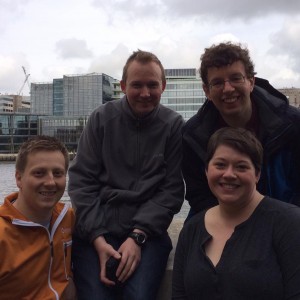
Our DASH 6 London teamDASH 6 was a considerable triumph, both in terms of the global hunt and the London leg specifically. No spoilers about the puzzles, not least because the event will be recast in Minneapolis at the very least, but the puzzles varied from entertaining to spectacular, the production values were very high and most of the puzzles required as much teamwork as you would hope for. London had a total of 21 teams over the two senior tracks, up from last year’s eight. The weather broadly held with only the fewest spots of rain, contrary to predictions of persistent showers all day at the least. Our GC team did a great job too. Indications are that the Magpie team won the London leg again, as expected; many congratulations to them! ClueKeeper was also a big winner on the day; a couple of teams reportedly had obvious glitches with no impact on gameplay but the system lived up to its potential.

If you care, our team had an excellent day and I think we performed competitively. We were very slow between locations (at the risk of TMI, I must have visited the little solver’s room ten times today in all the excitement, quite possibly fifteen) and so were left with a real rush against the eight hour deadline for the metapuzzle at the end, but we took hints with about six minutes to go and cracked it with maybe 31 seconds left on the clock!

Thanks to our GC, to the global co-ordinators, to all the puzzle authors and to all the lovely people I met (and solved with!) today. The post-DASH comedown is painful, but at least we know that a DASH 7 global co-ordinator has been named, so back to looking out for information again…