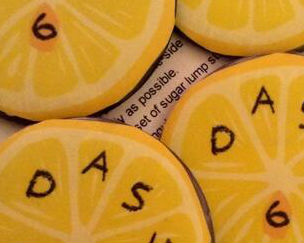
 As previously discussed, the Saturday after next will see the sixth DASH puzzle hunt take place in London and in a dozen cities across the US. We don’t know much about it, though this Tweet from a team running the playtest in Portland inspires the above picture and gets us thinking about “sugar lumps”. Hmm.
The DASH Facebook page has also been running a series of previews of local co-ordinators. Dan Egnor, who has forgotten more about puzzle hunts than I have ever known, has said on Google Plus “This is so gonna be in a puzzle…” – it’s not really the DASH way to feature pre-clues, but there’s always a first time, and nobody ever said “This is not a clue” – so perhaps, just perhaps, never a truer word spoken in jest.
The great scholarly work of puzzle hunt puzzle taxonomy is Joe DeVincentis’ MIT Mystery Hunt Puzzle Index. If ever you want to astound people with the breadth of what can be achieved in a puzzle, that categorises over eighteen hundred of the hardest. In a similar vein – though I must admit insufficient familiarity to be able to use the same categories as Joe – I have attempted a similar analysis on the puzzles of the first five DASH events to date:
2009 Palo Alto: music (identification from audio samples), letter links
2009 Boston: picture identification, poker, indexing
2009 Los Angeles: phonetic letters and numbers (NV = envy or single letters), indexing
2009 Washington DC: poker, indexing, reading vertically
2009 Houston: physical puzzle, paper dolls, logic puzzle based on elimination
2009 Portland: picture identification, westerns, Morse
2009 Seattle: crossword clues, overlapping words, reading last letters
2009 Palo Alto: wordplay induction to deduce hidden rules (sports teams, phonetic letters, A=1 B=2, double letters, phonetic alphabet, identify countries, palindromes)
2009 Meta 1: rock scissors paper, wordplay from puzzle names and answers
2009 Meta 2: semaphore, rock scissors paper, wordplay from puzzle names and answers
2010 Alvin and the Chipmunks: music (identification from audio samples), word rebus
2010 The Brady Bunch: identification of pictures, induction of common themes, sorting, indexing
2010 CSI: Orlando: identification of pictures, Disney movies, sorting, indexing
2010 Late Night with Conan O’Brien: identification of pictures, TV shows, hidden words within quotes, extraction of extraneous letters
2010 Dancing with the Stars: soundalike gibberish, constellations, combining pictures to spell letters
2010 How I Met Your Mother: wordplay linking pick-up lines and logos, braille
2010 LOST: crossword clues, sorting logos based on colour clues, indexing
2010 Star Trek: identification of characters, bases other than ten, arithmetic applied to letter numbers
2010 Twilight Zone (Meta): mapping phrases within answers to buttons on remote control, mapping data to lines to letters, using one physical prop on another built up during the hunt
2011 Snow White: Snow White character names, hidden words within quotes
2011 The Town Musicians of Bremen: music (identification from audio samples), dot-to-dot lines travel over letters
2011 Cinderella: creation of physical prop, recognising physical prop’s ability, identifying common letters in pairs of words
2011 Rumpelstiltskin: trivia questions, picture rebuses, recognising letter shapes
2011 Rapunzel: creation of physical prop, pattern matching, arithmetic applied to letter numbers
2011 Chicken Little: wordplay induction to deduce hidden rules, letter binary code, identifying letter patterns in grid
2011 Hansel and Gretel: wordsearch (slight variant), letters not used in wordsearch, wordplay induction to deduce hidden instruction
2011 Jack and the Beanstalk: creation of physical prop, wordplay induction to deduce hidden crossword clues, crossword clues, word rebus
2011 Three Little Pigs: number logic puzzle, crossword clues, induction of common theme
2011 Meta Puzzle: wordplay induction on previous answers, crossword clues, jigsaw, maze, symbol identification, indexing
2012 Golden Gate Bridge: crossword clues, identification of states, dot-to-dot lines travel over letters, letters not used in grid
2012 Mausoleum At Halicarnassus: wordplay induction to deduce hidden instruction, binary decoding, semaphore
2012 Temple of Apollo at Delphi: crossword clues, triple homophones, indexing
2012 Great Wall of China: identification of pictures, wordplay induction to deduce hidden instruction
2012 Lighthouse At Alexandria: geometry, wordplay induction to deduce hidden instruction, counting
2012 Great Pyramid of Giza: crossword clues, wordplay induction to discover hidden instruction for filling crossword, use of hidden instruction on diagram provided
2012 Statue of Liberty: anagrams, wordplay induction to discover hidden instruction, use of hidden instruction on diagram provided
2012 Tower of Babel: crossword clues, flavourtext induction to discover hidden instruction, rhymes
2012 El Castillo (Meta): creation of physical prop, wordplay induction to discover hidden instruction
2013 Verify the Disorder: sequence dialogue, hidden quotes, foods and words within dialogue, matching to diagrams, recognising letter shapes, dot-to-dot lines travel over letters
2013 Identify the Affected Area: crossword clues, wordplay induction to discover hidden instruction
2013 Discover the Infection: puns, anagrams plus extraneous letters
2013 Find Patient Zero: hidden connections, binary code
2013 Isolate the Infection: mini-puzzles, crossword clues, cryptic crossword clues, hidden words within quotes, anagrams
2013 Determine Transmission: crossword clues, overlapping words, use of physical prop
2013 Develop a Cure: identify pictures, wordplay induction to discover hidden instruction
2013 Plan Distribution Method: identify grid positions, flavourtext induction to discover hidden instructions
2013 Complete the Cure (Meta): wordplay induction on previous answers, creation of physical prop, jigsaw, hidden message
So what can we learn?
- DASH is pretty wordplay-heavy compared to many other puzzle hunts, and there have been relatively many “interpret the flavourtext, or the answers, or other wordplay in order to deduce hidden instruction” puzzles over the years.
- Common tropes: extracting unused letters from words or anagrams, wordsearches where the unused letters in the grid are somehow crucial, dot-to-dots where things crossed by the lines are crucial, identifying words hidden within phrases or longer pieces of text. The theming is normally pretty important, too. To be fair, none of these are particularly exclusive to DASH.
- The meta puzzle often relies on some commonality between the answers, so a really smart team might be able to start to identify that commonality even before they have all the answers, then presume the existence of the commonality in the answers that they have not yet reached. We haven’t had a meta that’s in part to do with the puzzle names for a while, so perhaps that might turn up again before too long.
- Some of the earlier DASHes relied fairly heavily on US culture, which I think was dialed down a little for DASH 5 now that the UK has entered the fold – and, given that there’s no reason why it couldn’t spread further around the (at least the English-speaking or English-speaking expat) world, this might decrease further still over time. I get the impression that one concession for London in DASH 5 is that we were presented with a list of US postal state abbreviations that we might not be expected to know but that US solvers might – and if there are any counterparts for further DASHes (lists of state capitols? Lists of Presidents and their numbering?) don’t expect them to be red herrings.
- Looking at the scoring, DASH 3 was unusually long compared to the others, with particularly many physical prop construction puzzles that slowed teams down. Another relatively long one may roll round again at some point.
- It’s not at all an admission of defeat to take hints; the median teams may or may not take hints, but taking a hint will not necessarily exclude your team from finishing in the top 20% of all teams, or maybe even significantly higher than that – particularly if you’re fast everywhere else in a relatively long year.
Really looking forward to this year’s event, not least to getting to see lots and lots of lovely people in the same place at the same time, even more than at a Puzzled Pint. More on that soon!