 A tip of the hat to David J. Bodycombe, of very considerable credentials in the puzzling world, and his contacts for this one.
It might sound like an “In Soviet Russia…” joke, but consider a game of the sort covered by this site – except that you don’t visit a physical location to play the puzzles, the puzzles come to you. That’s the principle behind The Mystery Box, currently in private beta-testing within downtown Toronto, Canada.
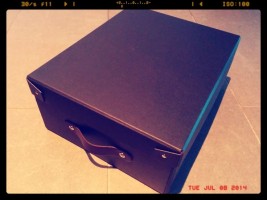
The titular box “contains a challenging puzzle with a unique mystery. The box contains seemingly random everyday items such as a pen, notebook, photos, deck of cards, etc. However, if you look closely, you’ll find clues and puzzles which will lead to closely guarded secrets!” Here’s a photo of the first iteration of the box’s contents. Click on either photo to find higher-resolution versions on the official Pinterest account.

Very cute and extremely interesting. The enterprise’s web site also suggests that We have multiple stories. Each one has different clues, puzzles and levels of difficulty. We’re also planning to introduce series – where one box opens another box – to allow you to experience longer, more exciting stories and puzzles which hints at these boxes doing things that exit games cannot currently do.
It is not yet clear whether the “downtown Toronto” restriction will be lifted (inter?)nationally in time, as it’s tempting to wonder if some physical puzzles could be included within the box that are so intricate that the postal services of the world might not be trusted with them. It’s well-known that some mechanical puzzles include all manner of sensors, which might not play well with a long-distance postal service. Either solution is possible; a strictly local service might feature the most advanced boxes, a more wide-ranging service might spread the fun to people who live outside convenient travel radius of an exit game. (Particularly in Canada, where the distances involved can be vast.)
“Puzzles through the post” games are not completely unprecedented; there have been passing mentions of the Black Letter Game from 2012, which has quite a heritage. People have been playing chess by mail for at least 200 years, quite possibly much longer, and more interesting games since at least 1970 (OK, arguably since at least 1963). As for, more specifically, puzzle games: that’s a topic for another day.