Sherlock unlocked?

Victorian detective silhouetteOne of the most familiar tropes in fiction is that of the Victorian London detective – and that’s a euphemism for one of them in particular, Sherlock Holmes, of Sir Arthur Conan Doyle’s original tales. He’s been in the news recently in terms of recent US court rulings over copyright; the Washington Post report is possibly the clearest, though the BBC one is worth reading as well.

Excerpting the Post: “For decades, the Doyle ((literary estate)) have jealously guarded all ‘literary, merchandising, and advertising rights’ for Doyle’s works. Anyone wanting to use Sherlock or his friend Dr. Watson has typically paid the estate a license fee.” However, an author has successfully argued in a US Appeals court that the characters are now in the public domain, and the Supreme Court has since rejected an appeal from the Doyle estate so the ruling stands.

The BBC make the distinction that “the character of Sherlock, along with 46 stories and four novels in which he has appeared, was in the public domain” though ten stories published between 1923 and 1927 do remain under copyright. Might this provide carte blanche to refer to Sherlock Holmes and other related characters within the context of an exit game, or a puzzle hunt, or some other puzzling endeavour? It’s known that some exit games around the world already do. It would be fascinating to hear whether the U.S. ruling might have implications on use of the characters elsewhere around the world.

The real-world story over who has the right to the address 221B Baker Street is rather fun; go to Baker Street and look between number 237 and number 241 for number 221B and you’ll find it leads to the Sherlock Holmes Museum – to whom, incidentally, the copyright of the graphic at the top of this post belongs. Perhaps some day it might lead to surely the most authentic of Sherlock-themed exit games, whether instead or as well. It would be likely to be about as expensive as an address would get, though.

Perhaps it’s marginally less unrealistic to hope for an exit game situated above Speedy’s Cafe on North Gower Street, famous for standing in for the location in the BBC’s latest version of the Sherlock tales. That would be fun, too!

Interview with Ed Roberts, proprietor of Breakout Manchester

Breakout Manchester description graphicThis site has previously discussed the Breakout Manchester exit game business, around two months old but already doing excellent business. It’s a joy to be able to feature an interview with Ed Roberts, the man behind the site. The questions asked by Exit Games are tagged with EG and Ed’s responses with ER below. The opinions are a little feisty in places; no bad thing at all, but be clear that they belong to Ed.

  • EG: What’s your background, leading up to the opening of Breakout Manchester?
  • ER: I’m a director in two other business, Awaken Ibiza and Funk Events, so up until opening Breakout I was running those companies. A lot of the skills developed in running these two businesses have been hugely beneficial in launching Breakout Manchester.
     
  • EG: It’s exciting to see your Tweets from time to time suggesting that Breakout Manchester is selling out days in advance. Can you say more about how well things are going for you?
  • ER: Yeah, things are going remarkably well. Another company opened in Manchester about 2 months before we did and I think it’s struggled. So for us to be selling out a few days in advance and weekends a few weeks in advance I’m really happy.
     
  • EG: Your excellent progress is all the more remarkable given that the site has only been open for about two months. What techniques have worked well for you at getting the word out around Manchester?
  • ER: My background is in advertising, marketing and promotion has been hugely beneficial. We use some fairly advanced social media techniques to promote the venue and I have done promotion in Manchester for the past 7 years I know a lot of people and organisation in the city which have been a big help. In addition to that, word of mouth is one of our strongest attribute, and that comes from people having an excellent experience with us and then those people spreading the word.
     
  • EG: Which puzzles, games and other artworks have influenced you most over the years in your designs?
  • ER: I really enjoy action computer games. Games such as Zelda, Dishonoured, The Room and The Room Two. Also TV programmes such as The Cube and The Crystal Maze. I’ve always been a huge fan of puzzles my whole life.
     
  • EG: What lessons has your background in event promotion taught you about offering good customer service?
  • ER: In terms of customers service probably not a huge amount, this is one thing I have learnt a lot of from doing Breakout. Where it has hugely helped is the promotion, marketing and advertising of the rooms and the venue.
     
  • EG: It was fun to read that representatives from first the Daily Sport and later the Bolton News have visited your site. Do you have any other star guests lined up?
  • ER: Not really guest stars but quite a lot of press will be coming through in the next few weeks.
     
  • EG: What does a typical day for you look like?
  • ER: I normally get to the venue around 7am and do around 3 hours on Awaken Ibiza or Funk Events. I then organise the staff for the day and spread my time between running the games, tweaking the games, promoting and advertising the venue. The venue is also incomplete so various DIY and decoration is still in place. To be honest for the past week it’s been non-stop running of games. I normally finish around 9pm.
     
  • EG: What are the most memorable reactions from players that you have witnessed?
  • ER: The other week we had 4 teenagers with behavioural issues in from Manchester Young Lives. They were accompanied by 3 teachers from the centre. They had all previously been expelled from numerous schools. The 4 of them absolutely loved it and were captivated from start to finish. Their teachers said their concentration spans were normally that of minutes and had never seen them working as a team before. Turning four disinterested teenagers into a team of happy, energetic and proud young adults was a very memorable moment. To see them rave about it afterwards really impacted me. A good escape room game is fantastic for all ages and in all situations. This particular example is a great example of this, and is testament to the quality of the room.
     
  • EG: How are your preparations going for adding a third room at your current location?
  • ER: Extremely slow 🙂 It’s the first room I’ve ever created completely by myself so I want to assure it’s as good as possible. It’s called Madchester so revolves around Manchester, its history and culture. Think the Hacienda, Stone Roses, Oasis, Coronation Street and so on. It will be open at the end of July if it kills me! 🙂 I’ve been to a few other sites around the country and with the exception of all the London sites, Leeds and one of the Bristol ones, some of them are very poor and I want to assure that my centre is as good as it possibly can be. If someone has a bad experience of an escape game it will put them off for life which would be such a shame.
     
  • EG: Can you reveal anything about your longer-term plans after that?
  • ER: We have the capacity to open another one maybe two rooms in Manchester so my focus is on that and to create some games which push the boundaries of the industry. I’ve got a lot of ideas of how escape rooms can break out of their current mould and I want to explore that. Why do they have to be an hour long for example? Could a escape room be more story driven? It’s exciting times for the industry as a whole.
     
  • EG: If you could give the readers, escape game players and puzzle fans reading this one piece of advice, what would it be?
  • ER: Play The Room and The Room Two on a tablet. Then come to Breakout 🙂

Thanks so much for that, Ed! Note also that last week, Breakout Manchester posted to their Facebook feed that:

Breakout Manchester is recruiting. We need game organisers, makers and technicians. Part time flexible hours available. Must have good customer service skills. If interested please send your CV to hello@breakoutmanchester.com and the days and hours that you are available to work.

Full-time and part-time roles are available, so as well as there being a good opportunity to play the site’s games, perhaps there’s a good opportunity for the right people to be involved from the other side as well!

Coming up this weekend: the Manorcon board games convention

Manorcon board games convention logoThis weekend sees the thirty-second annual Manorcon board games convention at the John Foster Hall in the University of Leicester, near Oadby. (The event gets its name from its original home, the Northfield Manor House at the University of Birmingham.) From 2pm on Friday 18th to 2pm on Monday 21st, probably a couple of hundred attendees or so will be there. The majority of games played will be from the last 20 years or so, but there will be plenty of classics as well – most notably, the late-’50s negotiation classic Diplomacy, though no one game comes close to dominating the event.

It’s reliably a great event – I went every year from about 1994 to 2002 or so – and registration will still be available at the door. (Some single rooms should still be available too if you want to stay over.) It’s particularly relevant to this site because every year since 2001, there has been a puzzle-based Treasure Hunt, normally for three hours or so on the Sunday afternoon. I ran the first event in 2001 and co-ran the second one in 2002; since then, it’s often been the previous year’s winners who go on to run the next year’s event.

This year’s ManorCon Treasure Hunt is being run by Dave Durant, Mark Fox and Annie Percik. This year’s theme is a Pirate Quest located in the island city of Bandar Lanun, famed for its cliff-side rope bridges and hanging prison cells. Trust in your crewmates and come armed with your wits. Five teams of up to six welcome – put yourself down on the sign-up sheets displayed all weekend.

A delightful theme, and Dave and Annie enjoyed learning what types of puzzles are suitable for team solving at DASH 6. If you’re not far from Leicester, you might well enjoy turning up between 2pm and 5pm on the Sunday for the Treasure Hunt – and, if you like board games, it’s very likely you’ll enjoy the whole weekend. (One other particularly interesting event is the Pop Quiz at 10pm on Saturday in the bar, run by site co-writer Phil Hannay. His event last year was delightfully off-beat, imaginitive and yet very accessible; it’ll be interesting to learn what he has this year…)

Coming soon to London: Lock and LOL

Lock and LOL graphicEdited 24/10/14: please be aware that Lock and LOL has gone out of business. There has been a more recent post detailing some of your options in case you have lost money to them. The rest of the post is quoted for completeness only.
It’s always a delight to hear about forthcoming exit game sites, though sometimes it’s a slight stretch to know what to be able to say about them in advance. This one looks exciting and has a very distinctive twist. London, prepare for the October 10th opening of Lock and LOL.

Lock and LOL describes itself as “the invisible live escape game” – more specifically, as clued by the graphic, “a unique interactive journey to an invisible world, where you have to find your way out in total darkness using only your senses of touch, hearing and smell […] This is the first escape game in the world which provides the same experience to blind and sighted teams alike. They can even race against each other with the same chances!” This site has never heard of something quite like that before. There has been passing mention of a dark start as the first challenge to one room, but playing the entire room in darkness will be a challenge to first-time exit game players and multi-site veterans alike. The degree of accessibility designed in is also extremely cool.

The web site points to a Kickstarter campaign, as well. Now the full truth is that crowdfunded campaigns for exit games have not been tremendously successful in the past, though we know of two sites that look like they’re making good progress after their crowdfunding campaign. (Fingers firmly crossed that we’ll have more to report from Edinburgh really soon, before Festival season starts in anger.)

The good news is that Lock and LOL has advanced plans for its first room even without crowdfunding; the site quotes an address (which has been added to the map), as well as a start date. The crowdfunding campaign would be for work on additional rooms and an improved lobby area “so guide dogs have a more comfortable space to wait while their owners are having fun“, which makes great sense. This is creative and delightful; do, please, consider doing your own research and think about backing the campaign if you can. More news on the site as it becomes available.

London is clearly very well served for exit games. Everyone knows how big a success HintHunt and clueQuest have been; Escape Land has also got off to a very strong start, selling out days in advance and already getting compliments on TripAdvisor, particularly for its staff.

We’re looking forward very much to Lock and LOL, but also to Escape Hunt, whose opening is now scheduled for September. And yet, and yet, this site is confident (read this with a conspiratorial *wink*!) that there will be least one more by the end of the year. Looking at the map and thinking about how non-trivial transport across London can be, there’s definitely room in west and south London for others.

Some might start to wonder whether the market might be oversaturated; this site thinks there’s a loooooong way to go before that. exitgames.hu now quotes Budapest as having as many as 57 games, as well as the occasional citations of Beijing being into triple digits. If that’s too much of an outlier for you, this site very much enjoyed this list with fourteen sites (totalling 44 rooms) in the province of Ontario, Canada, eight of which claim to be in Toronto alone. If you can get the word out, there’s clearly a lot of demand out there!

Around the World: the Mystery Box

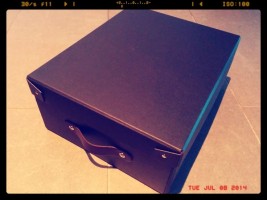
The Mystery Box from the outsideA tip of the hat to David J. Bodycombe, of very considerable credentials in the puzzling world, and his contacts for this one.

It might sound like an “In Soviet Russia…” joke, but consider a game of the sort covered by this site – except that you don’t visit a physical location to play the puzzles, the puzzles come to you. That’s the principle behind The Mystery Box, currently in private beta-testing within downtown Toronto, Canada.

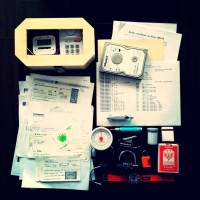
The titular box “contains a challenging puzzle with a unique mystery. The box contains seemingly random everyday items such as a pen, notebook, photos, deck of cards, etc. However, if you look closely, you’ll find clues and puzzles which will lead to closely guarded secrets!” Here’s a photo of the first iteration of the box’s contents. Click on either photo to find higher-resolution versions on the official Pinterest account.

Prototype contents of Mystery Box #1

Very cute and extremely interesting. The enterprise’s web site also suggests that We have multiple stories. Each one has different clues, puzzles and levels of difficulty. We’re also planning to introduce series – where one box opens another box – to allow you to experience longer, more exciting stories and puzzles which hints at these boxes doing things that exit games cannot currently do.

It is not yet clear whether the “downtown Toronto” restriction will be lifted (inter?)nationally in time, as it’s tempting to wonder if some physical puzzles could be included within the box that are so intricate that the postal services of the world might not be trusted with them. It’s well-known that some mechanical puzzles include all manner of sensors, which might not play well with a long-distance postal service. Either solution is possible; a strictly local service might feature the most advanced boxes, a more wide-ranging service might spread the fun to people who live outside convenient travel radius of an exit game. (Particularly in Canada, where the distances involved can be vast.)

“Puzzles through the post” games are not completely unprecedented; there have been passing mentions of the Black Letter Game from 2012, which has quite a heritage. People have been playing chess by mail for at least 200 years, quite possibly much longer, and more interesting games since at least 1970 (OK, arguably since at least 1963). As for, more specifically, puzzle games: that’s a topic for another day.

Milestone 100: a quick survey

Milestone showing the number 100Depending on whether you count the post with the map or not, either there have been 100 posts on this site already or this is the 100th post to this site. This has taken about four months, though this site has always been a “posts every now and again” site rather than a “new post every day” site. Grateful acknowledgements are due to Iain and Phil for their excellent posts along the way and potential contributors are warmly invited to get in touch.

It’s hard to know quite how many visitors the site gets. We have hit count statistics, but – for all WordPress blogs – it’s difficult to know how many of them arise as the result of automated spammers, whose attempted contributions are largely blocked; it might be 75% of our many hundreds of visitors per day, it might be 99.75%. Accordingly, it would be very much appreciated if you would take 45 seconds or so to fill in this anonymous survey, and a hundred posts is as good a milestone point as any. Tick as many or as few boxes as you like for each question; all the questions are completely optional, though participation may set a cookie on your computer.

Thank you for considering it![wwm_survey id=”0″]

Chess Puzzle Solving Championship

Chess problem by RetiYou may recognise the Réti endgame study above, argued to be one of the most famous chess problems of them all, or you may not. (White to play and draw against any defence.) This site contends that there are many – dozens? hundreds? – of little puzzle hobbies out there already, and that people who enjoy one may enjoy others that they did not previously know about. One of the best-developed of them all is that of chess problems, as codified in the UK by the British Chess Problem Society.

Their introduction to chess problems starts by arguing that there is much more than the puzzle element in a chess problem, then dissects the elements involved. (Could it be possible to take a similar approach to the sorts of puzzles more familiar to this site? It would be fascinating to see someone try; readers’ opinions on this would be most welcome.) The bottom of the introduction links to pages with more specific information about the types of chess problems which exist, of which the page on fairy chess problems is the most imaginative. This 2010 contest, by Serbia’s celebrated Nikola Zivanovic, organised through Logic Masters India of whom more before too long, uses the functionality of chess pieces in a more familiar puzzle context – almost approaching the issue from the reverse direction.

The British Chess Problem Society has a well-defined infrastructure, with an annual weekend-long convention, but arguably its focus is the British Chess Solving Championship, hereafter BCSC, which has been sponsored since 2009 by Winton Capital (also Mind Sports Olympiad solvers this year, so a tip of the cap to them). The BCSC has a starter puzzle as the (relatively!) gentlest of barriers to entry, then a correspondence round of eight puzzles to be completed and returned by post, this year by mid-August, with top solvers qualifying for an in-person final at the end of the following winter.

This in-person final consists of, usually, six short-ish rounds of (usually) two problems each, over the course of a long afternoon. The BCSC has over thirty years of history – and, to win it, you’ll have to beat not just Grandmasters but Grandmasters who have represented their country, over the board, at very high levels. From there, top performers advance to the World Chess Solving Championship, at which Britain has done extremely well in recent years, both in terms of individual solvers and also the national team. There is a great deal of classification and celebration of the best solvers – but also, possibly more importantly, the most prolific and accomplished problem constructors. While every mind sport is unique and holding up one as a template for others to follow seems unwise, that seems like excellent practice that could be usefully replicated in the world of puzzles.

So the chess problem hobby has intense depth; their championship begins with the starter problem, which attracts many hundreds of entrants and is free to enter, as of this year. The starter problem is widely distributed among the chess press, with a degree of competition between editors as to which one can inspire most entries, so look at your favourite source and you’ll find it. (For instance, one starting point could be Leonard Barden.)

Around the World: the Dark Ages

A monochrome image of a dark forestAround The World is an occasional series in which this site release its self-imposed general restriction of a focuses upon the UK and Ireland. There are have been a couple of really interesting stories about exit games in other countries recently, too good to miss, particularly when thinking about what exit games could be.

A news story about an exit game from Manila in the Philippines starts “Imagine yourself and a friend blindfolded, handcuffed and trapped in a room. You are being held hostage by a psycho killer who gave you an hour to solve his riddle so you can set yourselves free.” The images show the blindfolds are literal, though there is no evidence either way about the handcuffs.

This possibly should not come as a surprise, as another exit game from the country, Breakout Philippines, similarly blindfolds its players at the start. This site is not aware of any connection between Breakout Philippines and Breakout Manchester, or any other UK site that yet blindfolds its players, but never say never. That said, as it’s been in the Edinburgh Evening News, it’s probably not a spoiler to suggest that Escape’s Prison Break room sees teams start off quite literally in the dark, and the first challenge is to find out how to switch on the lights – a puzzle that has eluded some groups for up to 15 minutes.

This site also really enjoyed this New York Times article about exit games in Budapest; the latest count from exitgames.hu suggests that Budapest alone has 56 exit games – or at least 56 rooms, for there seem to be some sites with multiple one-room locations in the city. Either way, it’s a lot, and suggests how much room there remains for growth closer to home.

The New York Times article also lets this site put together more pieces of the jigsaw together that could be a history of the exit game tradition. Para Park (“Fear Park”) opened in Budapest in 2011, with this English-language article narrowing it down to June 2011 and claiming that Para Park was Budapest’s first. (It also suggests that founder Attila Gyurkovics was inspired by online room escape games, rather than directly by the original Asian in-person eit games that share the same inspiration.) A little further research on LinkedIn points to Istvan Rusvai opening the original, Hungarian, HintHunt early in 2012, before the London branch opened in April 2012. The rest is history.

The NYT article also provides another part of the trail by suggesting that many exit games have a Hungarian connection, either because they were started by an émigré, or because they’ve been designed and licensed by one. The Room, scheduled to open in Berlin in September, is one of the few exceptions; its chief executive, Jochen Krüger, is German. He got the idea from his partner, who had visited a live-action game in Tokyo. Together they went to Budapest, where, over the course of two days, they played eight different games. Sounds like a plan!

The International Puzzle Party

Possible International Puzzle Party logo, in the style of "Godel Escher Bach"There’s a huge global puzzle event taking place in London this August. The kicker is that it’s not the 23rd World Puzzle Championship, which the site has mentioned in at least a dozen posts to date. As the subject line suggests, it’s something quite different.

The focus is on physical, mechanical puzzles, and the International Puzzle Party web site explains the event as follows:

The purpose of the International Puzzle Party is to provide an annual forum for serious puzzle collectors for the exchange and sale of puzzles, books and related items, as well as for fun and fellowship. In short: puzzling fun for puzzling enthusiasts. International Puzzle Parties have been held almost every year since 1978. IPP’s are usually organized in three-year cycles in the USA, the Far East, and Europe.

Attendance at any International Puzzle Party event is by personal invitation only, from the hosting team. This is why the web sites of future IPP’s require a password. Please do not advertise future IPP’s to people who are not invited; do not even mention the exact locations nor dates.

Accordingly, the Puzzle Place calendar suggests that the next IPP will take place in London in August, but is no more specific than that. This secrecy is… well, it’s their business and nobody else’s, but as barriers to entry go, it’s pretty high. Perhaps it might be relevant that being a “serious puzzle collector” is not at all a cheap hobby – for instance, one of the few other resources about the event, Karl Scherer’s page, suggests people with only 500 puzzles might call themselves “small” collectors. These puzzles are precision craftsmanship, at the very least, so it seems reasonable to expect these collectors to be, perhaps, well-heeled, and the actual makers to be tremendously talented with their tools.

Part of the joy of the puzzle hobby (or, rather, the dozens of parallel little puzzle hobbies) is that you can engage with them in as much or as little depth as you like, and it seems surely likely to be accurate for mechanical puzzles as well. While the International Puzzle Party might choose to be exclusive, it has inspired other puzzle parties that are much more accessible. This site has mentioned the Midlands Puzzle Party in the past, with the Puzzle Place calendar quoting two more this year in early August and late October; additionally there’s the London Puzzle Party monthly, at 7pm on the second Tuesday of each month, at a Holiday Inn in Camden Town. The whole of Martin H Watson’s site is well worth a read; lots of good, mechanical-puzzle-focused, things to enjoy there.

Of course, it is probably just historical accident that Puzzled Pint also happens in London, starting at 7pm on the second Tuesday of each month; it seems very likely that people who enjoy one would also enjoy the other, though people would surely have a preference, probably for whichever one they were familiar with first. What are the chances of both events picking the same day of the month? One naive guess is “about 1 in 31”, but perhaps “about 1 in 15” is a more likely estimate; after all, people are likely to have competing demands giving them less time for such fun gatherings at weekends (and, perhaps, shoulder weekdays) – and maybe it’s somehow just too obvious to aim for the first week of the month…!

DASH stats 2: the difference between Experienced and New tracks

Close-up of plastic yellow lemon

After looking at whether there was a cultural gap, I next consider the difference between New and Experienced tracks. Here, I’m only going to look at those puzzles where there was a difference in content.

“First sale”, “Advertising”, “Viral marketing”, and (after compensating for the London difference), “Buyout” will be control puzzles. On these four identical puzzles, Experienced were significantly better players. The gap is least if New scores are increased by 4 or 5 points per puzzle.

Again, I think that a Student t-test is an appropriate method, comparing New to Experienced. My chosen data sets are the raw scores for teams completing each individual puzzle. Teams dropping out part-way through the day will contribute data for puzzles they solved.

“Collecting Ingredients II” involved solving cryptic clues. These cryptics were different between the tracks – New had a word in a sentence; Experienced had a partial anagram. Experienced needed to fully resolve the sudoku, New only needed the middle three letters, but I think that’s a marginal difference. The evidence suggests that Experienced teams performed worse than New, and the discrepancy goes away by allowing 2 points to Experienced. Given the advantage of Experienced teams on identical puzzles, we might add 6 to Experienced scores.

In “End of the First Day“, Experienced had a longer route to the answer, more letters to decrypt from ternary, and weren’t given the partial hint that there was decryption (but didn’t need to solve that partial hint). Many sides who got this puzzle got it very quickly (though I’ve discarded a team credited with the answer in 40 seconds), and it appears New sides were behind by 1 point. However, we might expect New to be further behind on equal puzzles, so add another 3 points to Experienced scores.

For “Practicing the Sales Pitch“, New had a much clearer hint that semaphore was involved, *and* a time limit more generous by 10 minutes. Experienced were clearly behind, by about 8 points. For our notional parity, try adding 12 to Experienced scores.

In “Mass Production“, there was a small difference – New were explicitly told there’s a word chain. Don’t think that’ll have altered the scores, and this proves to be the case – Experienced were up by 3 points. I can’t reject the hypothesis that there was no additional advantage to either track, so no change.

Finally, for “Memoirs“, New were told that these were rebuses, and given one of the least obvious initial answers, but penalised with a 10 minute shorter time limit. Experienced appears to have benefitted by about 9 points, so we might deduct 4 from their score.

Solely to compensate for differences in the puzzles, I suggest that New teams might deduct 17 points from their score and compare with Experienced sides. That would put the top New team, Colleen Werthmann, in a tie for 31st place; six New teams crack the overall top 100.