Personality types and exit games

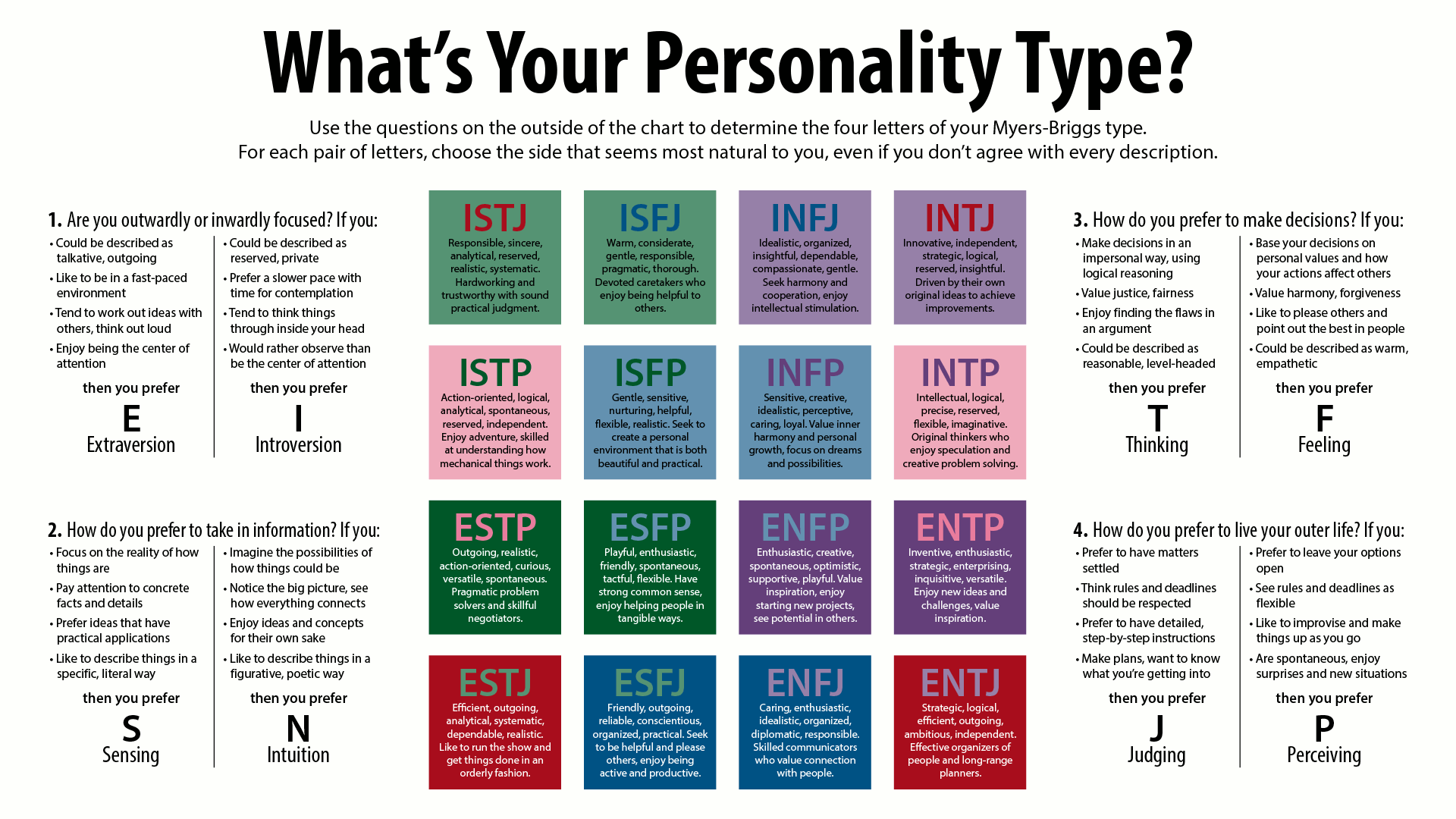
Myers-Briggs types. Adapted from http://commons.wikimedia.org/wiki/File:MyersBriggsTypes.png, released under CC BY-SA 4.0.

Click for larger version.

Some people put a lot of stock in the Myers-Briggs personality types. Other people compare it to a modern-day form of astrology, with all sixteen types being desirable in their own way and people choosing to self-identify with the commentary from their specific type through a process of self-directed cold reading. I tend to be somewhat more towards the latter end of the spectrum – but then, as an INTP, I would say that.

That said, I did enjoy the 16personalities.com summary of the INTP type. It’s quite possible that if you’re a MB person, you might have been able to see it coming through in this blog; “They love patterns ((…)) people with the INTP personality type tend to share thoughts that are not fully developed, using others as a sounding board for ideas and theories in a debate against themselves rather than as actual conversation partners“. Guilty as charged.

I also enjoyed the graphic at the top of the Prelude Character Analysis page for the personality type, being a certain sort of logic puzzle. It probably shouldn’t be a surprise that I thought “I recognise that puzzle – and I like it”! It might also explain why this blog keeps a diffuse focus in puzzle adventures and tries to interest people in logic puzzle competitions.

So this post is principally directed towards those who do tend to give credence to personality typing, specifically the MB types; if this isn’t for you, there’ll be another post along tomorrow.

Do exit games tend to attract certain sorts of personality types? Do certain sorts of puzzles in exit games tend to attract certain sorts of personality types? Is there any social science, pseudoscience or just plain tried-and-tested anecdotal received wisdom over why certain sorts of puzzles – irrespective of the quality and originality with which that puzzle is implemented – tend to play well with the sorts of people who would pay money to play an exit game? Could sites do more to help people find which of the several games they offer they would most enjoy based on players’ personality types? (Right, that’s almost enough underdeveloped theories for one post, you lovely sounding-board.)

I also enjoyed reading this recent Escape Games Review post, hinting at an exit game, themed around the Seven Deadly Sins, where every team member started off in a sin-themed mini-room of their own which they had to escape solo before they could work together towards a group victory. Could there some day be an exit game where players had individual puzzles to solve that were tailored towards their personality types – either to play to their strengths, or to force them to overcome their weaknesses?

A random thought about how friendly things are

animal-friendsGratuitous cute shot? There’s a little more to it than that, even if only a little.

Apropos of not much, one pleasing observation relating to the exit game hobby is how little disagreement and rivalry it has seen. It’s not as if – at least so far – there has been a tendency for people to swear allegiance to one brand of exit game and disdain the others, or those who are fans of others. When so many hobbies tend towards the tribal, it’s a pleasure that there has not been a sense of trying to establish commonality through a shared enemy. It’s fine to play some games from one company and have a great time, then play games from another company and enjoy them as well, and nobody makes accusations of a lack of loyalty.

Even the companies’ owners are on good terms with each other, as far as this site has been able to tell. (Some countries have seen occasional malign practices, but no authenticated evidence of them having spread to the UK yet.) This site tends to believe that competition isn’t a zero-sum game and a rising tide lifts all ships. It’s also true that different businesses’ games aim to do slightly different things; it’s cool that different sites emphasise subtly different emotional experiences.

At a guess, there are two reasons for the lack of development of brand… loyalty isn’t the right word, jingoism may come closer. The first is that, broadly, people will only play each game once and develop their skill at exit games in general rather than one exit game in particular, so people don’t need to feel the need to validate themselves by promoting the skill they have developed at their specific game through promoting that game at the expense of others. The second is that exit games tend to attract those with a taste for the thoughtful, possibly at the expense of the self-aggrandising.

The hobby is all the better as a result of it!

Mechanics Monday: Tutorial Mode

Video game "Tutorial Mode"The excellent Shut Up & Sit Down board games review site sporadically releases podcasts; one of them discussed, among many other things, the question “What can board games learn from video games?” Good question, and the obvious parallel question runs “What can exit games learn from video games?“. Especially because, arguably, the answer could be the same.

Many video games have tutorial modes which briefly introduce the mechanics of the game, often one at a time, often by making players learn through doing them. Not many board games have such a tutorial mode and there is an argument that that could be as good, or better, a way to learn a game’s rules than a rulebook. So the question is: could the same principle be used by exit games? Could an exit game start with a tutorial mode… or, perhaps, a tutorial room?

A tutorial room might have as few as three or four puzzles and be designed to be beaten within low single digits of minutes. It could be extremely small and would be designed to be extremely easy to reset, if work is needed to reset it at all. It would help the less confident teams out so that they might hit the ground running when they go into the “real” room. It could help people learn what they’re required not to do for safety reasons. It would offer a perception of extra value. Lastly, it could be used to… not mislead, but explore design choices that were deliberately not incorporated in the real room.

Yesterday, this site discussed Dr. Scott Nicholson’s white paper, which has been updated since the last post with even more content. One particularly interesting suggestion in it is that hiding information by writing it in ink that might only be seen using a supplied blacklight is something of an exit game cliché in this day and age. Perhaps it might be appropriate to use this mechanic in a tutorial room and not actually in a main room, in that case.

On the other hand, given that exit games have thrived already without needing tutorial rooms, perhaps this is a solution in need of a problem. It may well be that part of the thrill is exploring the possibilities for the first time in your first room, being dropped into it and discovering for yourself what you can do. Perhaps a tutorial room could be an optional extra for the most marginal and least confident participants.

Returning to the overarching question of what might be learnt from video games, Dr. Nicholson also writes: Since escape rooms are hoping to meet the needs of many different player types, they should allow the players the ability to set their game mode. This will provide a way for a group of players to communicate to game staff what kind of game experience they are seeking. ((…)) Facilities with a human gamemaster can easily adjust the difficulty of the game experience by giving more frequent or more cryptic clues. ((…)) Another tip to take from videogames to enable a better player experience is to allow teams to switch to an easier mode while playing the game, so that if they are frustrated, they have a way to resolve that frustration before the game is over. There is some established practice in this regard: De Code Adventures of Canada offers a choice of three levels of difficulty in this regard, though it’s not clear whether the extremely sensible “jump down a difficulty level while the game is in progress” option is possible.

One way for an exit game to conclude, which wouldn’t be appropriate for many themes but could be hard to beat thematically for others which nod more directly at video games, would be for the countdown clock to count down to zero and then display the familiar “GAME OVER” motif. People would expect that. However, if beneath “GAME OVER”, there were to be a secondary message of “CONTINUE?” and then an additional short countdown timer, that would surely play with a few sets of expectations, maybe in just the right way!

An academic approach to exit games

scholarshipOne of the most interesting developments in the world of exit games over the last few months has been the scholarly investigation undertaken, as discussed, by Dr. Scott Nicholson, a Professor at Syracuse University in New York state. Dr. Nicholson has a long history in research with a focus (among others!) into different forms of play in the context of informal learning spaces such as libraries.

Late last year he launched a survey of exit game facilities, discussing the thinking behind his survey at his site Escape Enthusiasts. This has developed into a Google Group for discussion of the genre, with a counterpart Facebook group as well. The highlight has been publication of (at least an early version of) the white paper arising from the survey, which gets this site’s highest recommendation as a must-read for business owners and players who want to see behind the scenes.

One particular highlight of the white paper is the very neat way that it handles the claim that exit games date back to Silicon Valley in 2006. Additionally, it presents remarkably comparable prior art dating back at least a decade further to (as discussed) a series of games run at the LARP-themed International Fantasy Gaming Society’s “Once Upon A Con” events, which created a series of temporary rooms through hanging up tarpaulins and challenged teams to make their way through within time limits. It’s always an exciting possibility that there are other, similar games from decades ago that time has forgotten and that might present themselves again some day.

The demographic information that the white paper presents is fascinating, with the most robust attempt yet to compare self-reported practices in exit games around the world, with the best corpus of data yet collected from English-speaking Asia, as well as Australia, Europe and the Americas. This will inspire and inform those looking to set up their own new business, as well as those looking to develop their existing one. There’s plenty of information collected, too, about what might be found inside these rooms as well as who might be playing them, and about what just might be possible and practicable inside a room.

This site has always deliberately erred on the side of being relatively liberal in its focus with discussion of near-topic games such as True Dungeon, but did so on a vague sense of it being hand-wavily interesting. The white paper takes the scholarly approach that these things are not just interesting, but they are relevant because they have identifiable influence, even if at a remove or two, on the way in which the world knows exit games today and how it might know exit games in the years to come. Six different influences are identified and it takes a real breadth of ludic knowledge to pull them all together.

Jumping from the start to the end, the notion in the white paper that most excited this site is the counterpart way that exit games are put in context as a subset of live-action adventures. Look at it another way: if you look up an exit game on TripAdvisor, it’ll be ranked in the context of “Fun Activities and Games”, and it’ll compete against – for instance – paintball, go-karting, casinos, laser tag and soft play. Is this a rag-bag assortment or are there lessons to be learned for exit games from some of them? Not so much from casinos and probably only tangentially (in the briefing-with-instructions, activity, debriefing schedule) from go-karting – but, as for the others, maybe there’s more in common than you think. If people like laser tag because they want to be inside a video game like Halo, perhaps they like exit games because they want to be inside a video game like Myst.

This site enjoys reading about live-action adventures, though sometimes hiding behind the sofa. This site isn’t going to become a live-action adventure blog, though. (Laser tag, although it will always be cool, is moving in a direction that this site does not appreciate so much; it’s becoming much less Half-Life and much more Call of Duty. No thanks.) Additionally, this site has always considered interactive theatre to be on the border of its remit, with playable theatre (if that’s a term anybody else uses, noting the many meanings of the word “play”…) definitely on-topic.

Putting it all together, this site loves puzzle adventures; they might involve being in a room, they might involve being in a puzzle hunt (whether online or in person), they might involve being part of a competition. However, it’s much easier for a puzzle competition to feel like an adventure in your head if there is some structure, context and persistence to them, rather than just being one-off tests – for instance, the adventure of being part of a team and helping your team advance through your progress. If this breadth of approach isn’t to your taste, other blogs are available. You should start your own; this site would link to it!

Looking forwards, Dr. Nicholson will be the keynote speaker at an upcoming “escape room Game Jam” held at MIT in greater Boston. Teams will have (nearly) 48 hours to “create puzzles and games to be played within a pop-up escape room (…) based around a moment in an upcoming film“. (It’s not clear which film; a film will be screened at the start of the event, so that would seem likely to be the inspiration.) Intriguingly, this is being held in association with Red Bull and winning participants get an expenses-paid trip to Comic-Con 2016. Not bad! The event has sold out, but will be filmed and the material generated will be made available under a Creative Commons licence.

Perhaps, in time, the world at large might get to play the winning, or a composite, pop-up exit game when the film gets a wider release; it wouldn’t be the first film to have a pop-up exit game associated with it – the one associated with The Purge: Breakout showed what might be possible. It’ll be extremely interesting to see if anything ever develops as a consequence of this Game Jam and to follow additional developments as they arise.

Exit games have taken off so rapidly that the world can hope to attract attention from all sorts of different sources and to be intepreted in all sorts of different ways. The exit game world should be very grateful to have someone who has professional academic expertise casting an eye over it, as well as us amateurs; that might sound dismissive, but it’s intended as a compliment – remember, an amateur is someone who does something for the love of it.

(Unrelatedly, if you haven’t done so already, please would you consider filling out this site’s survey? Thank you!)

Spring 2015: where are the gaps in the UK market?

Regions of the UKAward yourself some smugness if you can recognise the (admittedly out-of-date, so no need to be pedantic) approximate way in which the countries have been divided above.

Every six months or so, this site looks at a snapshot of the UK market for exit games and analyses where the gaps are at that time. (See the older versions from September 2014 and March 2014.) Six months is practically the duration of a geological era considering how quickly the exit game market moves.

It’s possible that some of the first exit game room proprietors might have started business in the closest big city to where they happened to already live. However, if you had a choice as to where to set up business, where are the most obvious gaps in the market? Alternatively, where might people expect to see exit rooms coming soon? In early 2015, now that some of the most successful operations have started second or even third locations in different towns, where remains up for grabs?

The Brookings Institution analysed 300 of the largest metropolitan economies in late 2012 and identified 15 of them as being in the UK. At time of writing, here are the 15 largest metropolitan economies in the UK, alongside the number of exit rooms featured in each one. If there’s a large metropolitan economy without an exit room, there’s arguably a gap in the market there.

1. London: nine sites operating (HintHunt, clueQuest, Escape Land, Escape Rooms, Agent November, Escape Hunt, Room Escape Adventures, Mystery Cube and Lock’d) and at least three sites under construction (Enigma Escape, Mystery Squad and Quest Room) with rumours of at least a couple more
2. Birmingham: two sites operating (Keyhunter and Escape Live) and at least one site under construction (Panic!) with rumour of at least one more
3. Manchester: four sites operating (Make A Break, Breakout Manchester, Lockin Escape and The Escape Room) and two sites operating nearby (Clue HQ in Warrington and Escape Quest in Macclesfield)
4. Leeds-Bradford: two sites operating (Tick Tock Unlock and Locked In Games) and two sites operating nearby (The Live Escape in Huddersfield and GR8escape York in York)
5. Liverpool: four sites operating (Clue Finders, Tick Tock Unlock, Breakout Liverpool and Exit Strategy) and one site operating nearby (Clue HQ in Warrington)
6. Glasgow: one site operating (Escape) and one site under construction (The Room)
7. Nottingham-Derby: one site operating (Logiclock)
8. Portsmouth-Southampton: no sites operating or under construction known but one site operating nearby (Cyantist in Bournemouth)
9. Bristol: one site operating (Puzzlair) and one site operating nearby (Bath Escape in Bath)
10. Newcastle: three sites operating (Escape, Lost and Escape and Exit Newcastle)
11. Sheffield: two sites operating (The Great Escape Game and Crack The Code Sheffield)
12. Cardiff-Newport: no sites operating or under construction known
13. Edinburgh: three sites operating (Escape, Escape Hour and Can You Escape?) and one site under construction (Dr. Knox’s Enigma)
14. Leicester: one site temporarily closed (Cipher)
15. Brighton: no sites operating and only unconfirmed rumours of sites under construction

For comparison, the Dublin metro area (where XIT and ESCAP3D are in operation and Escape Dublin is under construction) would come just below number three in the above list.

Six months ago, this pointed to Merseyside, the East Midlands, Tyneside and South Yorkshire as being big gaps that have been filled extremely successfully over time. (Arguably Liverpool going from zero sites to four in the space of about four weeks might be filling the city more quickly than some of the proprietors would like.)

The updated data now points to South Hampshire and Wales as being the biggest gaps in the market at the moment, and Wales is such a popular tourist destination that it’s the place that this site keeps checking and checking to see whether there’s been a launch – but there’s really no evidence in either North Wales or South Wales. This site is convinced that someone could really clean up in Cardiff at the very least, but probably wouldn’t want to run the fourth site to open there.

Other than that, Brighton surely has the feel of somewhere really promising because of the number of tourists it gets and the extent to which it is famous for its creativity (though at least one major global brand lists it as “coming soon”) and there are Home Counties towns that have serious money (Reading and maybe Watford) and/or serious numbers of tourists (Southend) which might well sustain good business from people who don’t want to spend the transport costs to go to central London to play. Further afield, Stoke, Derby, Leicester and even Hull are all surely big enough to support a site each, and there’s evidence to suggest that other relatively small locations can support a “boutique” site which has such an elaborate and enticing game as to draw enthusiasts from further away.

Exciting times, though not without a note of hesitation. With forty-some sites up and running and likely at least another ten or twelve to come, this site would be somewhat more cautious than it would have been even six months ago about new sites’ prospects. That said, there are still very many (probably millions, certainly many hundreds of thousands) people who might only ever play an exit game once who are yet to play their one game, as well as those who might enjoy their first game enough to come back to play more, and those – who this site salutes! – who know the genre’s capability to thrill and devote themselves to seeing all there is to see.

The League Table: end of February 2015

Stacks of coins, increasing in height

This is the eleventh instalment of an occasional feature to act as a status report on the exit games in the UK and Ireland. On its own it means little, but repeated sufficiently many times it could be the basis of a survey of growth over time.

The Census

Category Number in the UK Number in Ireland
Exit game sites known to have opened 42 2
Exit game sites known to be open 38 2
Exit game sites in various states of temporary closure 2 0
Exit game sites known to have closed permanently 2 0
Exit game sites showing convincing evidence of being under construction 8 1
Exit game sites showing unconvincing evidence of being under construction 4 0
Exit game projects abandoned before opening 2 0

The term opened should be understood to include “sold tickets”, even when it is unclear whether any of those tickets may have been redeemed for played games; the definition of site should be understood to include outdoor sites and component parts of larger attractions that are played in the same way as conventional exit games.

This month, four sites have opened and Jailbreak! has moved from “open” to “temporary closure”, on the strength of expectations of a second, bigger, better and possibly permanent opening. March 2015 looks set to be the biggest month for exit games in the UK and Ireland yet, with seven UK sites and one Irish site all selling tickets for various dates over the course of the month.

The Report Card

Site name Number of exit rooms Number of different games Number of TripAdvisor reviews Number of 5/5 TripAdvisor reviews TripAdvisor’s “thumbs up” percentage Local TripAdvisor ranking
Agent November 2 2 27 26 100% 97
Bath Escape 2 2 69 57 95% 12
Breakout Games Aberdeen 3 2 – – – –
Breakout Manchester 7 6 260 235 97% 3
Can You Escape 1 1 67 65 98% 9
Cipher 1 1 – – – –
Clue Finders 2 1 9 9 100% 46
Clue HQ 2 2 306 288 99% 1
clueQuest 5 2 968 904 99% 17
Crack The Code Sheffield 1 1 7 6 – 61
Cryptopia 1 1 26 23 100% 15
Cyantist 1 1 10 9 100% 11
Escape Edinburgh 3 3 327 296 99% 5
Escape Glasgow 3 2 102 98 100% 1
Escape Hour 2 1 60 58 100% 8
Escape Hunt 10 3 86 66 93% 145
Escape Land 1 1 99 86 100% 64
Escape Live 2 2 27 27 100% 2
Escape Newcastle 2 1 30 26 100% 3
Escape Quest 1 1 27 26 100% 1
Escape Rooms 2 2 117 86 94% 152
Escape Rooms Plymouth 1 1 30 27 96% 6
ESCAP3D Belfast 1 1 112 85 87% 32
ESCAP3D Dublin 2 1 14 6 71% 191
Ex(c)iting Game 2 2 60 42 95% 9(*)
GR8escape York 1 1 34 34 100% 2
HintHunt 5 2 1208 1119 98% 22
Jailbreak! 1 1 – – – –
Keyhunter 3 3 57 30 82% 33
Lock’d 1 1 – – – –
Locked In Games 2 2 144 138 99% 2
Logiclock 1 1 15 15 100% 4
Lost & Escape 1 1 – – – –
Make A Break 1 1 57 38 85% 24
Mystery Cube 1 1 8 7 – 297
Puzzlair 2 2 114 109 99% 3
Room Escape Adventures 1 1 1 1 – 680
The Escape Room Manchester 5 5 40 39 100% 2
The Great Escape Game 1 1 49 47 100% 1
The Gr8 Escape 2 2 35 30 97% 18
Tick Tock Unlock Leeds 1 1 342 328 99% 1
Tick Tock Unlock Liverpool 2 1 13 13 100% 23
XIT 4 4 14 10 100% 108

This needs to be taken with a heavy pinch of salt. This site supports all the exit games that exist and will not make claims that any particular one is superior to any other particular one. Please note that the TripAdvisor rankings represent a wide variety of locations and cannot be directly compared against each other. In fact, it’s definitely pushing it even to compare the TripAdvisor rankings of two exit game sites in the same city, and here’s why:

What a palaver; TripAdvisor have been playing around with their ranking system again. On balance, this site believes that the latest round of changes are a marginal net positive for exit games. It appears that sites will still be compared against other activities (or, in one asterisked case, attractions) in the same location, and this month, the rankings quoted above are the overall activities rankings. On the other hand, if you go and look at the TripAdvisor page for any particular site, you will see a ranking not relative to activities but to some smaller category. Normally this is Fun & Games, but sometimes it’s whatever else TripAdvisor feels like; at least one city has its indoor exit games ranked under Outdoor Activities. If you look at TripAdvisor on a mobile device, it’ll show you the activities rankings; on a desktop, the Fun & Games rankings.

One happy conclusion of this is that, for instance, six of the top ten listings in London for Fun & Games are all exit games. That can’t be bad at all. In general, the more sites that can be number one, the happier all round. One unhappy conclusion is that this will make the number one statuses slightly less meaningful and slightly less visible. One very confusing conclusion is that it’s evidently possible for one site to be ranked ahead of another in the activities chart but for the two sites to be ranked the other way around in the Fun & Games chart. (This happens in at least two cities.) There is no definite reason to prefer one ordering over the other.

In that case, why does this site quote the activities rankings? Two bad reasons: continuation of established practice, which is never a good justification on its own; even less justifiably, convenience – for these rankings are the ones quoted on this one single page. Thoughts on this are welcome (though responses from site operators of “do whatever makes my site looks best…” will be taken with a smile) but it may well be the case that next month the other set of rankings are quoted, or possibly even no rankings at all.

Nevertheless, congratulations to all those sites who are proud of the rankings they have worked so hard to achieve. It’s particularly delightful to see Sheffield’s The Great Escape Game reach number one, and also at least three sites making very rapid progress to reach number two in their city as well. There are many other new sites where highly elevated rankings are surely just a matter of time and continued excellent reviews, as well.

This site makes an estimate that the number of people who have played at least one exit game in the UK or Ireland, at any point in time up to the end of February 2015, is 155,000. (This estimate is quoted to the nearest 5,000, but the site would not like to claim more confidence than “…to within an order of three either way”.) As ever, if someone plays more than one game at the same site, this figure still only counts them once, and this number is only really meaningful in the context of this site’s previous estimates. The other usual caveat is that this figure may exclude data from locations about which this site is ignorant – and in researching this, this site has just found another site that opened in early January. More about that soon!

The League Table: end of January 2015

Bar chart heading upwardsThis is the tenth instalment of an occasional feature to act as a status report on the exit games in the UK and Ireland. On its own it means little, but repeated sufficiently many times it could be the basis of a survey of growth over time.

The Census

Category Number in the UK Number in Ireland
Exit game sites known to have opened 38 2
Exit game sites known to be open 35 2
Exit game sites where the Sword of Damocles is poised to fall 1 0
Exit game sites known to have closed permanently 2 0
Exit game sites showing convincing evidence of being under construction 4 0
Exit game sites showing unconvincing evidence of being under construction 4 0
Exit game projects abandoned before opening 2 0

The term opened should be understood to include “sold tickets”, even when it is unclear whether any of those tickets may have been redeemed for played games; the definition of site should be understood to include outdoor sites and component parts of larger attractions that are played in the same way as conventional exit games.

You may observe that a second site has moved into the “closed permanently” category; farewell to Cryptopia of Bristol. The last game played here might actually have taken place as long ago as May 2014, but the site has only recently been updated to say “Please note we are no longer available for bookings. Cryptopia is for sale!“, sufficiently convincing for this site to declare it no more. Perhaps there might be a second incarnation at some point, but with sufficient water under the bridge that it might be considered a sequel.

The Report Card

Site name Number of exit rooms Number of different games Number of TripAdvisor reviews Number of 5/5 TripAdvisor reviews TripAdvisor’s “thumbs up” percentage Local TripAdvisor ranking
Agent November 2 2 21 20 100% 122
Bath Escape 2 2 52 44 97% 10
Breakout Games Aberdeen 3 2 – – – –
Breakout Manchester 7 6 239 215 97% 3
Can You Escape 1 1 51 51 100% 4
Cipher 1 1 – – – –
Clue HQ 2 2 267 251 99% 1
clueQuest 5 2 924 861 99% 15
Crack The Code Sheffield 1 1 7 6 – 12
Cryptopia 1 1 26 23 100% 12
Cyantist 1 1 6 5 100% 21
Escape Edinburgh 3 2 290 262 99% 7
Escape Glasgow 3 2 75 73 100% 1
Escape Hour 2 1 53 51 100% 9
Escape Hunt 10 3 70 55 92% 152
Escape Land 1 1 92 80 100% 61
Escape Live 2 2 6 6 100% 24
Escape Newcastle 2 1 19 17 100% 5
Escape Quest 1 1 21 20 100% 1
Escape Rooms 2 2 109 79 93% 162
Escape Rooms Plymouth 1 1 9 8 – 49(*)
ESCAP3D Belfast 1 1 111 84 87% 35
ESCAP3D Dublin 2 1 13 6 76% 192
Ex(c)iting Game 2 2 57 39 94% 11(*)
GR8escape York 1 1 26 26 100% 5
HintHunt 5 2 1175 1087 98% 22
Jailbreak! 1 1 – – – –
Keyhunter 3 3 56 30 83% 28
Locked In Games 2 2 109 103 98% 2
Logiclock 1 1 7 7 100% 12
Make A Break 1 1 55 36 86% 30
Mystery Cube 1 1 1 1 – 530(*)
Puzzlair 2 2 108 104 99% 1
Room Escape Adventures 1 1 1 1 – 662
The Escape Room Manchester 5 5 10 10 100% 18
The Great Escape Game 1 1 15 14 100% 6
The Gr8 Escape 2 2 31 27 96% 20
Tick Tock Unlock 1 1 314 302 99% 1
XIT 4 4 10 6 100% 142

This needs to be taken with a heavy pinch of salt. This site supports all the exit games that exist and will not make claims that any particular one is superior to any other particular one. Please note that the TripAdvisor rankings represent a wide variety of locations and cannot be directly compared against each other. In fact, it’s probably pushing it even to compare the TripAdvisor rankings of two exit game sites in the same city. Rankings are highly volatile, possibly to a fault; imagine a site with 99 5/5 ratings and 1 1/5 rating – the ranking is likely to be rather different if the 1/5 rating is the most recent one, posted today, than if it is the first one and the site has been on a long perfect streak ever since. (Oh, and there was one site which managed to get every single review with a 5/5 rating but TripAdvisor somehow decided it had only got 96% thumbs up.)

Please do remember that TripAdvisor have reclassified exit games from being attractions to being activities so positions cannot be directly compared to those from before November 2014, though three sites (marked with asterisks above) are somehow being ranked as attractions rather than as activities, which might yet change over time.

This site makes an estimate that the number of people who have played at least one exit game in the UK or Ireland, at any point in time up to the end of January 2015, is 135,000. (This estimate is quoted to the nearest 5,000, but the site would not like to claim more confidence than “…to within an order of three either way”.) As ever, if someone plays more than one game at the same site, this figure still only counts them once, and this number is only really meaningful in the context of this site’s previous estimates. The other usual caveat is that this figure may exclude data from locations about which this site is ignorant.

An unusual month for exit games in the UK. On the plus side, new openings as far north-east as Aberdeen and as far south-west as Plymouth show the spread of the genre all around Great Britain; on the minus side, many well-established sites may be seeing that activity may be a little down on that of previous months as people recover from what will have been in many cases an expensive Christmas. Offers and promotions over the festive period were infrequent, but the country is starting to see them again towards the end of January. There was a very slight trend towards marginally less excellent reviews in London than was previously the case; perhaps London is becoming a tougher market than once it was.

Looking ahead to 2015: predictions for the year

Crystal ballThis site ran a predictions feature over the second half of 2014 then assessed the accuracy of its predictions. More strictly, the piece was a series of probability estimates, which is not quite the same thing. This year, to make things more explicit, this site will split its estimates into challenges, which represent interesting predictions that have an outside chance of happening but this site considers to be less likely than not to happen in 2015, and actual predictions, which this site considers to be more likely than not to happen in 2015.

CHALLENGES

There is a 5% chance that an exit game business sufficiently motivates and enthuses its staff to vote it into the top twenty of the next Sunday Times “Best Small Company to Work For” list.

There is a 10% chance that the newspapers will find a new style of puzzle that attracts half as much public attention as sudoku. There is a 80% chance that the newspapers will claim they have done, but only a 10% chance that it will actually stick in close to the way that sudoku has.

There is a 15% chance that the world will gain a second global monthly puzzle event. There’s a definite reason for one to exist: the wonderful Puzzled Pint is for the benefit of the community, which (generally) goes to visit a different venue each month in each city. Suppose there were a second event run for the benefit of the venues; individual bars (etc.) could adopt the event, pledging to host a puzzle night in their location each month. There are places that would find that a compelling attraction!

There is a 20% chance that some company brings larger-scale live escape events to the UK, with relatively many teams playing the same game at once. (For those who get the distinction, think Real Escape Game as opposed to Real Escape Room.)

There is a 25% chance that the 25th anniversary of The Crystal Maze, which will happen on 15th February this year, will see a reawakening of interest and the show will catch the public mood once more.

There is a 30% chance that one of the big players in the leisure industry starts a chain of exit games within its own facilities, or teams up with an existing exit game business which wants to expand rapidly by opening in a number of facilities. For instance, if you’re going to go to either of the branches of the real-snow indoor ski slope Xscape, you know you’re prepared to spend money, and the chance to play “Escape at Xscape” would surely be irresistible…

There is a 35% chance that the UK team produces its best performance in the next World Puzzle Championship, beating its previous best of sixth from the twenty national “A” teams in Beijing in 2013.

There is a 40% chance that another UK city develops a puzzle community like that of London, with at least one regular monthly event and at least one larger annual event – maybe as simply as hosting its own Puzzled Pint and DASH events, maybe something of its own. All it takes is someone willing to be the first onto the dancefloor.

There is a 45% chance that the UK mass media will catch on to just how cool exit games are. Maybe the “The One Show” team will go and play, or someone will take the idea to Dragon’s Den, or The Apprentice might consider them to be sufficiently zeitgeist-y to take an interest. At the top end, this site might dream of a revival of The Adventure Game, which effectively featured (among other things) room escape games a good thirty years ahead of the time.

PREDICTIONS

There is a 55% chance that at least one exit game will earn the Living Wage Employer mark. Perhaps there is at least one out there which pays the stipulated wage already. This site doesn’t believe that every exit game can afford to pay the stipulated level; indeed, many owners, especially of very new games, will be some way from covering costs, and consistent wage rises might force them out of business outright. However, perhaps there’s a business out there who would take pride from going down this route.

There is a 60% chance that the next World Puzzle Championship will be won by Ulrich Voigt of Germany, which would be his eleventh overall and the first time anyone has ever won four in a row.

There is a 65% chance that the exit game industry continues to grow sufficiently quickly that this site’s estimate for the number of unique players in the UK or Ireland by the end of December 2015 reaches or exceeds half a million… and this site will not attempt to fix the figures just for the sake of proving this relatively weakly-held prediction correct.

There is a 70% chance that at least one exit game will start to advertise itself using a formal endorsement from a reasonably well-known, mainstream national or international celebrity.

There is a 75% chance that the Puzzled Pint community of London will continue to grow, flourish, with teams getting to know each other ever more closely and look forward to meeting each other at the other puzzle events that exist through the course of the year.

There is a 80% chance that eleven or twelve of the calendar months of the year will see at least one new site open for business in the UK or Ireland.

There is a 85% chance that there will be a UK-based exit game review blog set up this year, to which this site will very happily link. There are many different sites out there who want the publicity from the reviews that they might get; be any good (goodness knows, this site doesn’t set the bar high) and proprietors will be climbing over themselves to invite you to play!

There is a 90% chance that the London leg of DASH 7 will expand from 8 teams in 2013 and 21 teams in 2014 to at least 25 teams for 2015. The London capacity for 2013 and 2014 was 25 teams, so it’s quite possible that London DASH might well sell out.

There is a 95% chance that at least two existing exit games covered by this site will officially call it a day. These don’t have to be unhappy endings; for instance, Oxford Castle are listing their Jailbreak event as happening until the end of January only, then presumably they will put the game cleanly back in its box. Fingers crossed that they choose to get it back out again at some point.
The semester report for late 2014

Calendar for second half of 2014This site was looking for an image of half a calendar, covering only the last six months, and thus searched for JASOND. Perhaps it shouldn’t have come as a surprise to get pictures of a R&B singer-songwriter…

The single months’ worth of TripAdvisor that are tracked in the League Table feature are only really meaningful as snapshots in time. However, with sufficiently many of them, it is possible to draw slightly more meaningful trends – or, at least, to reflect on how far the industry has come. The Timeline shows that the number of open exit games in the UK more than doubled over the first half of 2013, more than doubled again over the second half of 2013, doubled over the first half of 2014 and more than doubled once more over the second half of 2014. (Those numbers: 1 to 3 to 7 to 14 to 30.) Past performance is not an indicator of future results, as you may have previously been told, which is just as well or the metaphorical king’s chessboard will become swamped with rice.

So, for the sites that have stood the test of time, it’s worth looking back to where they were six months ago and compare that to how they are doing now. Here’s the situation from six months ago:

Site name Number of exit rooms Number of different games Number of TripAdvisor reviews Number of 5/5 TripAdvisor reviews Proportion of 5/5 ratings
Breakout Manchester 2 2 30 28 97%
Cipher 1 1 – – –
Clue HQ 1 1 1 1 (*)
clueQuest 3 2 493 472 96%
Cryptopia 1 1 25 22 88%
Escape 2 2 29 29 100%
Escape Land 1 1 1 1 (*)
ESCAP3D 1 1 81 68 84%
Ex(c)iting Game 2 2 21 15 71%
HintHunt 5 2 846 783 93%
Keyhunter 3 3 39 25 64%
Make A Break 1 1 25 16 64%
Puzzlair 2 2 45 44 98%
Tick Tock Unlock 1 1 25 25 100%
XIT 4 4 4 3 (*)

Across the population, that’s 1,532 5/5 reviews out of 1,665, a proportion of 92%. The (*) symbol represents a population of fewer than ten reviews, where a proportion is not particularly meaningful. Now let’s consider the same sites again, but only those reviews posted in the second half of 2014:

Site name Number of exit rooms Number of different games Number of recent TripAdvisor reviews Number of recent 5/5 TripAdvisor reviews Proportion of recent 5/5 ratings
Breakout Manchester 4 4 150 133 89%
Cipher 1 1 – – –
Clue HQ 2 2 232 217 94%
clueQuest 5 2 381 348 91%
Cryptopia 1 1 1 1 (*)
Escape (Edinburgh) 3 2 226 204 90%
Escape Land 1 1 80 68 85%
ESCAP3D (Belfast) 1 1 28 16 57%
Ex(c)iting Game 2 2 32 21 66%
HintHunt 5 2 292 270 92%
Keyhunter 3 3 16 5 31%
Make A Break 1 1 25 16 64%
Puzzlair 2 2 53 50 94%
Tick Tock Unlock 1 1 221 210 95%
XIT 4 4 4 2 (*)

Across the population, that’s 1,578 5/5 reviews out of 1,741, a proportion of 90½%. Again, the (*) symbol represents a population of fewer than ten reviews, where a proportion is not particularly meaningful.

There is nothing to suggest that the market has decreased in quality over the last six months; surely the opposite is true. It might be tempting to suggest that the novelty of exit games among the reviewing has faded, resulting in a fall of 5/5 scores across the population from 92% to 90½%, but that difference is so small that it might well arise through the noise of random chance and is not statistically significant to a particularly meaningful level. (OK, a χ2 test suggests it might be approaching significance, but if you accept that level of significance then you’re going to go on a lot of wild goose chases.)

If one particular site had been getting 100 reviews with 90% 5/5s previous to one half-year and then another 100 reviews with only 75% 5/5s in a half-year then there might be cause for alarm, but the sample sizes here are generally so small that there are only a very few cases in which the observed lowering of the percentage for a particular site is at all meaningfully significant. Run your own tests!

In conclusion: exit games were awesome up until the first half of 2014, and have been just as awesome in the second half of 2014 as well.

The League Table: end of December 2014

Bar chart showing improving performance over time

This is the ninth instalment of an occasional feature to act as a status report on the exit games in the UK and Ireland. On its own it means little, but repeated sufficiently many times it could be the basis of a survey of growth over time.

The Census

Category Number in the UK Number in Ireland
Exit game sites known to have opened 33 2
Exit game sites known to be open 30 2
Exit game sites where the lights are on but nobody’s home 2 0
Exit game sites known to have closed permanently 1 0
Exit game sites showing convincing evidence of being under construction 4 0
Exit game sites showing unconvincing evidence of being under construction 4 0
Exit game projects abandoned before opening 2 0

The term opened should be understood to include “sold tickets”, even when it is unclear whether any of those tickets may have been redeemed for played games; the definition of site should be understood to include outdoor sites and component parts of larger attractions that are played in the same way as conventional exit games.

The Report Card

Site name Number of exit rooms Number of different games Number of TripAdvisor reviews Number of 5/5 TripAdvisor reviews TripAdvisor’s “thumbs up” percentage Local TripAdvisor ranking
Agent November 2 2 20 19 100% 120
Bath Escape 2 2 49 41 97% 10
Breakout Manchester 4 4 180 161 97% 3
Can You Escape 1 1 21 21 100% 25
Cipher 1 1 – – – –
Clue HQ 2 2 233 218 99% 1
clueQuest 5 2 874 820 99% 14
Cryptopia 1 1 26 23 100% 12
Cyantist 1 1 3 3 – 21
Escape Edinburgh 3 2 255 233 99% 4
Escape Glasgow 3 2 68 66 100% 1
Escape Hour 2 1 36 35 100% 11
Escape Hunt 10 3 61 48 91% 148
Escape Land 1 1 81 69 100% 72
Escape Live 2 2 – – – –
Escape Newcastle 2 1 8 7 – 10
Escape Quest 1 1 14 14 – 1
Escape Rooms 2 2 92 70 97% 117
ESCAP3D Belfast 1 1 109 84 89% 32
ESCAP3D Dublin 2 1 13 6 76% 162
Ex(c)iting Game 2 2 53 36 94% 12
GR8escape York 1 1 16 16 100% 8
HintHunt 5 2 1138 1053 98% 21
Jailbreak! 1 1 – – – –
Keyhunter 3 3 55 30 86% 22
Locked In Games 2 2 66 63 98% 2
Logiclock 1 1 4 4 – 18
Make A Break 1 1 50 32 86% 21
Puzzlair 2 2 98 94 98% 1
Room Escape Adventures 1 1 – – – –
The Great Escape Game 1 1 – – – –
The Gr8 Escape 2 2 28 24 96% 21
Tick Tock Unlock 1 1 246 235 99% 1
XIT 4 4 8 5 100% 115

This needs to be taken with a heavy pinch of salt. This site supports all the exit games that exist and will not make claims that any particular one is superior to any other particular one. Please note that the TripAdvisor rankings represent a wide variety of locations and cannot be directly compared against each other. In fact, it’s probably pushing it even to compare the TripAdvisor rankings of two exit game sites in the same city. Remember that TripAdvisor have reclassified exit games from being attractions to being activities so positions cannot be directly compared to those from before November 2014.

Things are starting to settle down in the activity era. Some sites are making good progress; a salute to Escape Glasgow for getting to number one on a second chart. This site is especially delighted to see the developments in Leeds, where the activities chart has exit games at both number one and number two. The highest of fives to both Tick Tock Unlock and the fast-rising Locked In Games, and it’ll be interesting to see whether exit games in West Yorkshire continue to grow further still. (There’s a spa in Huddersfield stopping the West Yorkshire one-two, which perhaps should watch out!)

This site makes an estimate that the number of people who have played at least one exit game in the UK or Ireland, at any point in time up to the end of December 2014, is 120,000. (This estimate is quoted to the nearest 5,000, but the site would not like to claim more confidence than “…to within an order of three either way”.) As ever, if someone plays more than one game at the same site, this figure still only counts them once, and this number is only really meaningful in the context of this site’s previous estimates. The other usual caveat is that this figure may exclude data from locations about which this site is ignorant; for instance, last month’s figures should have covered Escape Hour which opened in November, but didn’t.

Another way of looking at it is that this site believes that exit games in the UK and Ireland were, perhaps, a two-million-pound industry in 2014. This might represent an increase on 2013 by a factor of somewhere in the reason of 5-8. Another similar increase again in 2015 would seem ambitious, but you never know!